
Know all ye by these presents that Annie Machon is hereby honored with the traditional Sam Adams Corner-Brightener Candlestick Holder, in symbolic recognition of her courage in shining light into dark places.

“If you see something, say something.” Long before that saying came into vogue, Annie Machon took its essence to heart.
MI5, the British domestic intelligence agency, recognized how bright, enterprising, and unflappable Annie was and recruited her as soon as she completed her studies at Cambridge.
The good old boys in MI5 apparently thought she would have a malleable conscience, as well — such that she would have no qualms about secret monitoring of the very government officials overseeing MI5 itself, for example.
Annie would not be quiet about this secret abuse. Her partner, David Shayler, an MI5 colleague and — like Annie — a person of integrity and respect for law, became aware of an MI6 plan to assassinate Libyan leader Muammar Gaddafi.
They decided to blow the whistle and fled to France. (Many years later, a woman of high station but more flexible integrity openly gloated over Gaddafi’s brutal assassination.)
After three years on the lam, hiding mostly in France, they returned to the UK, where Annie was arrested (but never charged with a crime). The powers-that-be, however, chose to make an example of Shayler (not unlike what they are now doing to Julian Assange).
Shayler’s whistleblowing case dragged on for seven years, during which he did a brief stint in the infamous high-security prison where Julian Assange still rots (having been denied bail, yet again). A strong mitigation plea by Annie helped reduce Shayler’s remaining prison time. All in all, though, what he was forced to endure took a hard toll on him.
More broadly, the issues that surfaced around whistleblowing at the time remain largely the same two decades later. Annie Machon has been a very prominent and strong supporter of Julian. She has also been a much admired mentor to less experienced women and men as they seek to become better informed on issues of integrity and courage, and take Annie up on her offer to “help them meet interesting people”, as she puts it.
We would be remiss today were we not to call to mind the courageous example of our first two awardees, Coleen Rowley (FBI) and Katharine Gun (GCHQ), who took great risks in exposing malfeasance and in trying to head off the attack on Iraq. And, as Julian Assange did when he won this award, we again honor his treasured source, Chelsea Manning, for her continuing courage and scarcely believable integrity.
Ed Snowden, our Sam Adams awardee in 2013, noted that we tend to ignore some degree of evil in our daily life, but, as Ed put it, “We also have a breaking point and when people find that, they act.”
Annie is still acting, as one can see as this World Ethical Data Forum unfolds.
Presented this 17th day of March at the World Ethical Data Forum by admirers of the example set by the late CIA analyst, Sam Adams.
Related Articles
Invitation to 2024 Sam Adams Award Ceremony on Nov. 2 in Washington D.C.

All are invited to the 21st annual Sam Adams Associates for Integrity in Intelligence Award ceremony to be given in memoriam to Aaron Bushnell, in recognition of his remarkable action in taking his own life to alert the world to the terrible crime of the US-Israeli genocide of Gaza, which has now spread to the West Bank and Lebanon.
It is hoped that US and UN officials who have spoken out and/or resigned/retired as a result of their opposition to and the deceit surrounding the ongoing genocide of Palestinians will attend as our honored guests.
Our Sam Adams award ceremony and reception is scheduled to be held from 7-9 pm on Saturday evening, November 2, at the Busboys and Poets Restaurant event rooms, 450 K St. NW, Washington D.C.
The event is sponsored by the Eisenhower Media Network.
Make your reservation at https://www.eventbrite.com/e/sam-adams-award-ceremonyreception-honoring-aaron-bushnell-in-memoriam-tickets-1047960426847?aff=oddtdtcreator and more info at: https://www.busboysandpoets.com/events/th-evt-43719520/
The award ceremony will be livestreamed at:
https://www.facebook.com/N2Sreports
https://www.youtube.com/channel/UCbBm6SZ235HFxwVKC7Po5IA and
US Soldier Who Burned Himself to Death Over Gaza Wins Sam Adams Associates Award for Integrity in Intelligence
In presenting its 2024 award, the Sam Adams Associates says it salutes Aaron Bushnell’s courage in performing a vital public service at the greatest cost — martyrdom — for truth-telling. (published in Consortiumnews on Sept 19, 2024)

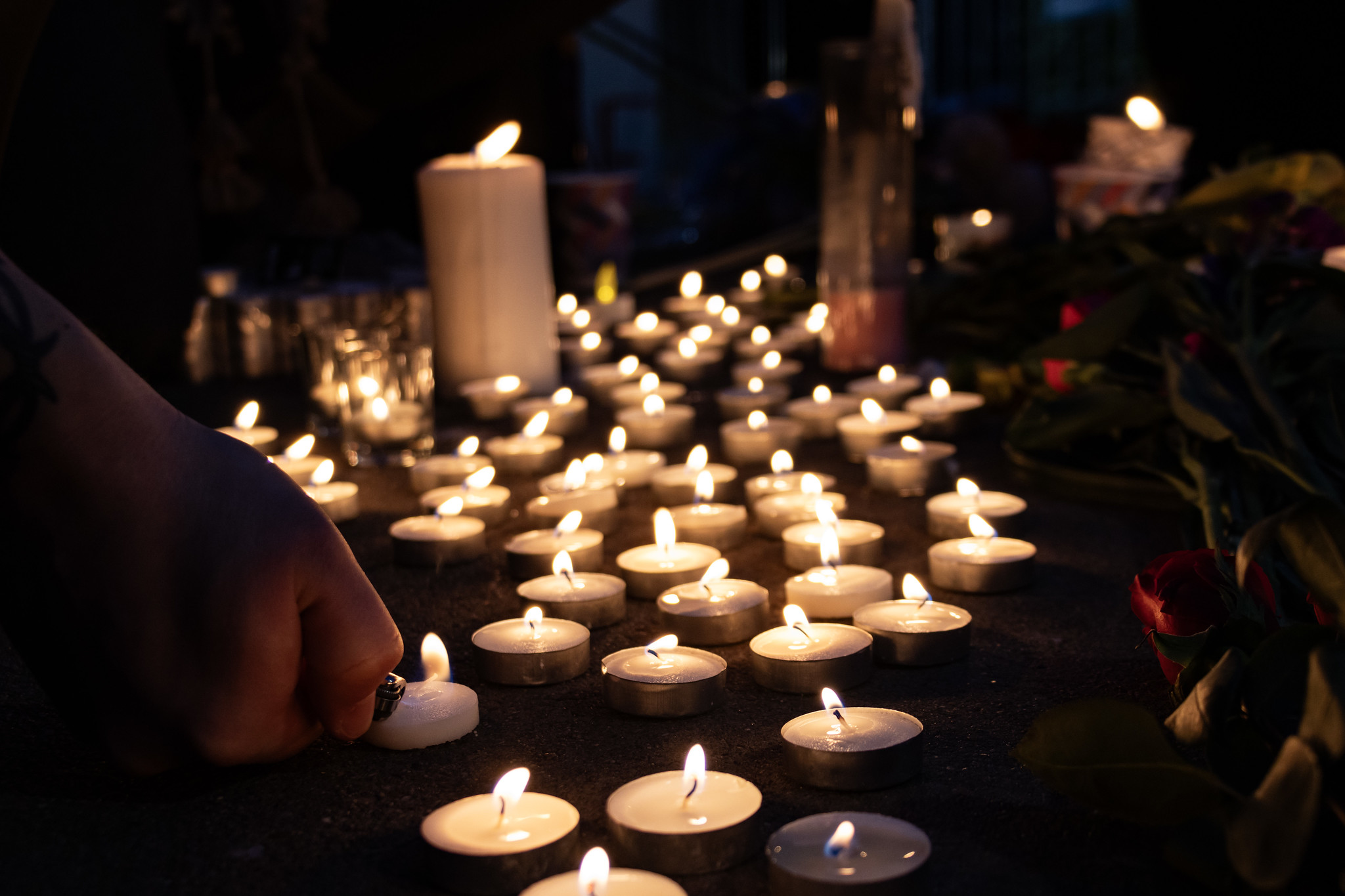
Vigil on Feb. 27, 2024, outside the Israeli Embassy in Washington for Aaron Bushnell, a U.S. airman who self-immolated to protest the Israeli genocide in Gaza. (Diane Krauthamer, Flickr, CC BY-NC-SA 2.0)
A notice from the Sam Adams Associates:
The Sam Adams Associates are pleased to announce United States Air Force Senior Airman Aaron Bushnell as the recipient of the 2024 Sam Adams Award for Integrity in Intelligence.
Bushnell was a cyber defense operations specialist with the 531st Intelligence Squadron at Joint Base San Antonio-Lackland. He was assigned to the 70th Intelligence, Surveillance and Reconnaissance Wing at Fort Meade in Maryland.
Senior Airman (SRA) Bushnell martyred himself when he walked up to the Israeli embassy in Washington, D.C., on Feb. 25, 2024, while streaming himself as he approached, and then self-immolated in protest of what Israel is doing to Palestinians, the most extreme form of protest. He was 25 years old and had been on active duty since May 2020, according to the service.
He had stated as he approached the embassy:
“My name is Aaron Bushnell, and I am an active duty member of the United States Air Force. I will no longer be complicit in genocide. I’m about to engage in an extreme act of protest but, compared to what people have been experiencing in Palestine at the hands of their colonizers, it’s not extreme at all. This is what our ruling class has decided will be normal.”
In an earlier on-line post, later identified as from SRA Bushnell, he’d written: “I have been complicit in the violent domination of the world and I will never get the blood off my hands.”
In advance of his burning, Bushnell posted this message on his Facebook page:
“Many of us like to ask ourselves, ‘What would I do if I was alive during slavery? Or the Jim Crow South? Or apartheid? What would I do if my country was committing genocide? The answer is, you’re doing it. Right now.”
As he was consumed by flames, SRA Bushnell’s last words were, “Free Palestine,” said repeatedly.
This was not an act of suicide, as some would have us believe, though SRA Bushnell acted out of despair of any other means of protest having an effect in stopping Israeli genocide and U.S. complicity in that. He obviously suffered the moral injury that so many U.S. service members suffer from when they come to realize their role in, as SRA Bushnell put it: “I have been complicit in the violent domination of the world and I will never get the blood off my hands.”

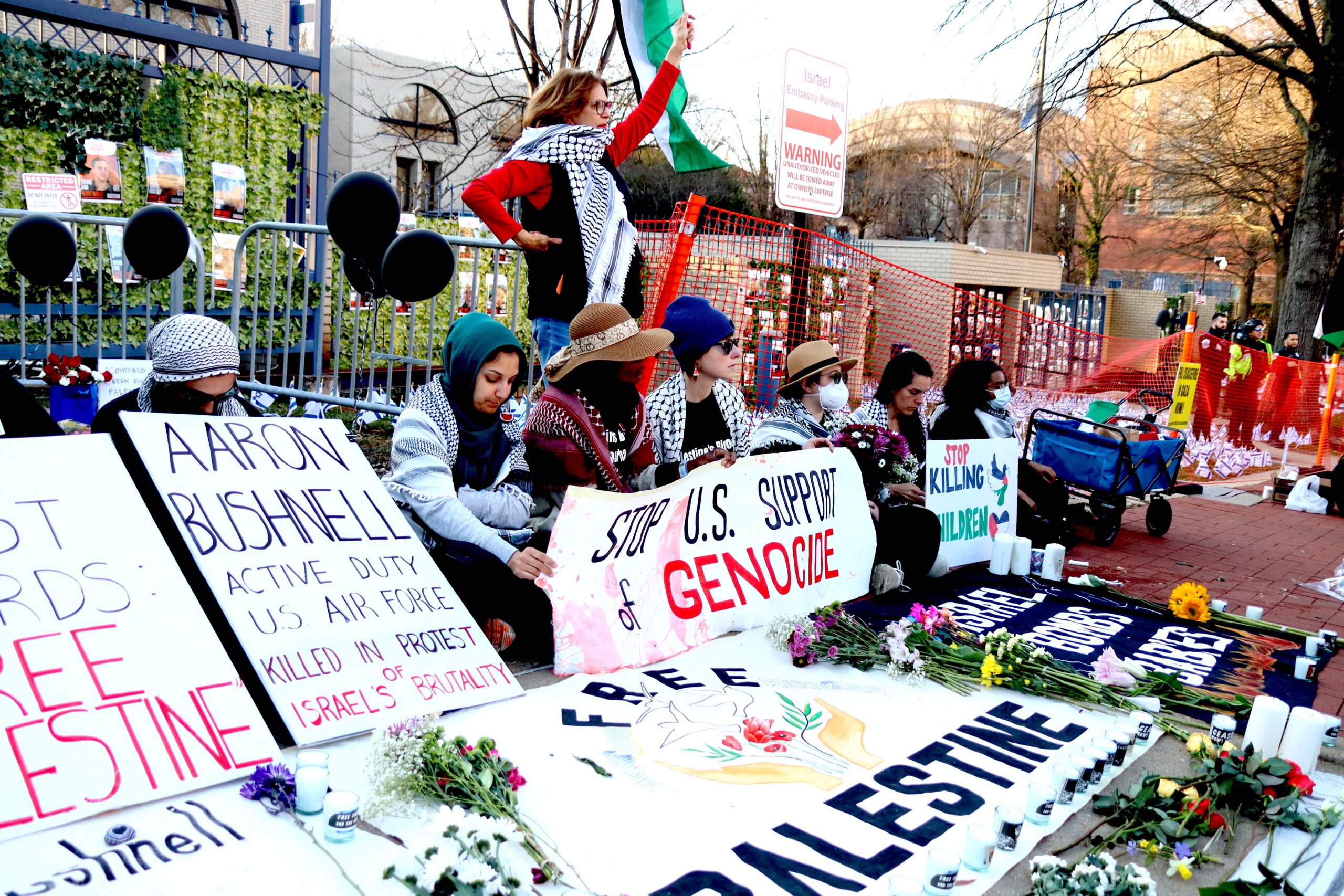
Feb. 26, 2024: A vigil in Washington for Aaron Bushnell, the active-duty member of the U.S. Air Force who self-immolated outside the Israel embassy to avoid being complicit in genocide. (Elvert Barnes, Wikimedia Commons, CC BY-SA 2.0)
But in SRA Bushnell’s case, his actions made him a “Whistleblower,” in the finest tradition of many of the other Sam Adams Awardees, in that he was acting in opposition to what the Israeli Defense Forces and the Israeli government describe as “Cognitive Warfare.”
Or the “Battle for Consciousness,” of the world’s population, which accompanies Israel’s illegal treatment of the Palestinians being held under illegal military occupation, in denial of that illegality. Here is how it is described in an Israeli book on that “Battle for Consciousness,” or “Public Diplomacy”:
“The IDF speaks about consciousness: ‘The strategy of limited conflict is to win a decision of ‘consciousness in the society with the help of military means. The battle is for the society’s consciousness and for national resilience. Decision is achieved through maneuvering to raise doubts and generate a sense of persistent uncertainty.’”
Senior Airman Bushnell seriously upset the preferred narrative in Israel’s so-called “Public Diplomacy,” or more correctly, “Cognitive Warfare” as the “Battle for Consciousness.”
In that, in his opposition to genocide, SRA Bushnell was acting in the finest tradition of past U.S. heroes who took it upon themselves to undertake missions knowing the only possible outcome was certain death, in sacrificing their life for a noble purpose.
That’s not “suicide.” It’s martyrdom, in the spirit of the most exalted people in history.
Perhaps inspired by Sr. Airman Bushnell, numerous other government employees have sacrificed their careers in protest of Israel’s genocide and U.S. complicity in that. We honor all of them too, with this Award, though presented in Aaron Bushnell’s name.
The Sam Adams Associates wish to salute the courage of Aaron Bushnell in performing a vital public service at the greatest cost — martyrdom — for truth-telling.
We urge an end to U.S. complicity in the ongoing Israeli genocide taking place before the world’s eyes, and legal accountability for all engaged in that genocide, Israeli and American. To that end, the public’s right to know about their government’s wrongful actions — including the adverse consequences of policies carried out in their name — must be respected and preserved.
SRA Bushnell is the 21st awardee of the Sam Adams Award for Integrity in Intelligence. His distinguished colleagues include Daniel Ellsberg, Julian Assange and Craig Murray, who have all paid heavy prices for truth-telling.
But Senior Airman Aaron Bushnell voluntarily paid the highest price, a price we wish no one to pay. But in endless U.S. wars “in the violent domination of the world,” we must expect our service members to feel the righteous despair that Aaron Bushnell wrote of: “I will never get the blood off my hands.”
Other fellow Sam Adams Award alumnae include NSA whistleblower Thomas Drake; F.B.I. 9-11 whistleblower Coleen Rowley; and GCHQ whistleblower Katharine Gun, whose story was recounted in the film Official Secrets.
Sam Adams was a C.I.A. whistleblower who exposed the U.S. official lie about the strength of Viet Cong forces.
The full roster of Sam Adams awardees is available at samadamsaward.ch.
Tags: Aaron Bushnell Sam Adams Associates for Integrity in Intelligence
A Celebration of Daniel Ellsberg
JOE LAURIA: Memories of Dan Ellsberg
By Joe Lauria
Special to Consortium News
I first met Daniel Ellsberg, who died on Friday at 92, inside a House committee hearing room on Capitol Hill in 2006. It was a hearing about whistleblowers. We were both sitting towards the back of the sparsely attended room.
I don’t recall how we began speaking, but I had just returned from a trip to Vietnam and Dan voraciously questioned me about my experiences there. He wanted to know if I thought the motive for U.S. involvement had been economic or purely ideological. He didn’t know me from a hole in the wall. But that apparently was of no consequence to him.
Among his many supremely, human traits was that as a man as famous as he had become, he didn’t succumb to the awful, unapproachable egoism that well-known people can bestow on themselves. There are many journalists speaking or writing now about their experiences with Dan. That’s because he was open to any serious person who had a curiosity about the things that intensely interested him.
Later that year, in 20o6, I was invited to a 35th anniversary dinner at the Mayflower Hotel in Washington to commemorate the passing of the Pentagon Papers from Ellsberg to Senator Mike Gravel in 1971.
I only briefly spoke with Dan that night, but a year later I had a book contract to tell Gravel’s story. Mike had become a candidate for the 2008 Democratic presidential primary. Dan agreed to write the foreword to the book (and pointed out how many people mistakenly called it a “forward” instead of “foreword”). As he was a major part of Gravel’s story I interviewed him for the book.
During one interview I was on the phone with Dan in an empty Amtrak train headed to Washington. In the distance, at the other end of the car, a guy was standing who looked exactly like the arch-neocon Bill Kristol. I told Dan. He said, “If you talk to him tell him ‘Fuck you from Dan Ellsberg.” But we returned to the interview.
I regret not going up to the guy to ask him if he was Kristol. If he was, I would have handed him the phone and told him I have Dan Ellsberg on the line and he has something he wants to tell you. (I especially regret it after John Kiriakou’s story in CN about Ellsberg.)
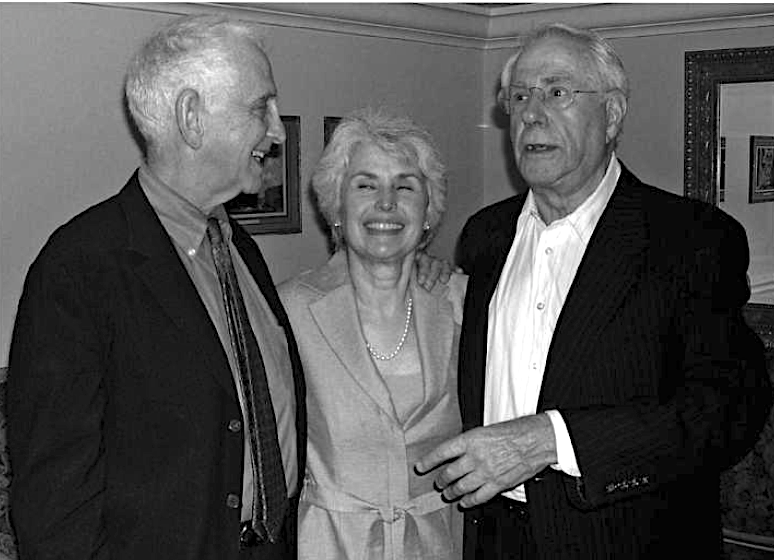
Dan Ellsberg, Whitney Stewart Gravel with Mike Gravel at 35th anniversary of the transfer of the Pentagon Papers, June 2006. (Joe Lauria)
Ellsberg told me he had gone in 1971 to several senators, including George McGovern, who was running for president, asking them to read the Pentagon Papers into the Congressional Record because they had constitutional immunity. They all chickened out.
Dan told me he initially thought that if a senator read the Papers in Congress then the newspapers would report on it, and what he was revealing would become known. But then he figured out it happens the other way around: the Senate actually reacts to the press, not the press to the Senate.
So he leaked the Papers to The New York Times. After just two days, the Nixon Department of Justice shut down publication on June 15, 1971. The Times had published very little of the 7,000-page study in the two days before the injunction. On the very next day, Ellsberg arranged to send the Papers to Gravel, the only senator who had the guts to take them and read them into the record.
Cover of A Political Odyssey, 2008. (Seven Stories Books)
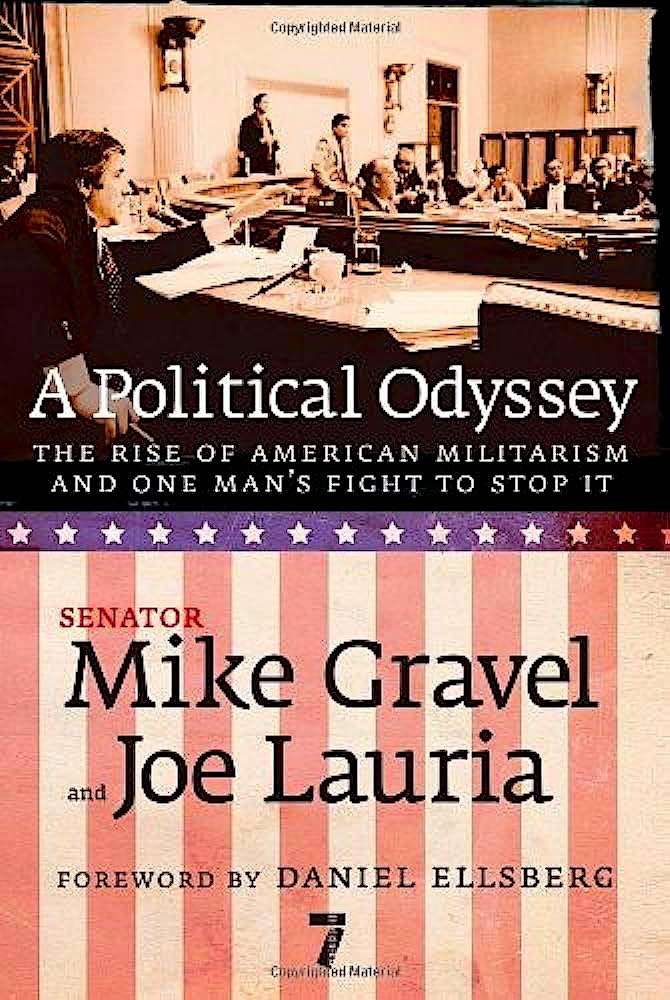
Ellsberg had learned that Gravel was conducting a filibuster to stop renewal of the military draft and he called Gravel, asking him if he wanted a copy of the Pentagon Papers.
They made an arrangement whereby Ellsberg, who was hiding out from the F.B.I. in a motel in Cambridge, MA, gave copies of the Papers, bound by a dog’s leash, to Ben Bagdikian, then an editor at The Washington Post. One copy was for the Post and one for Gravel.
Bagdikian, who said he felt uncomfortable as a journalist being a messenger to a U.S. senator, bought two seats on a flight from Boston to Washington. One seat was for him, and the other for the Papers.
Bagdikian and Gravel met in front of the Mayflower Hotel a few blocks from the White House, where they transferred the Papers from Bagdikian’s car to Gravel’s. Then they went inside to have a drink, as Gravel told me, as though nothing special had happened.
Gravel then spent days cutting off “Top Secret” from each page. Ellsberg surrendered at a federal courthouse in Boston on June 28, 1971. The next day Gravel brought the Papers onto the Senate floor to read them as part of his filibuster. A suspicious Republican senator figured Gravel he was up to something, seeing a big flight bag next to his desk.
In fact one Democratic senator, Ed Muskie, came over and jokingly asked Gravel on the Senate floor, “What the hell do you have there Mike, the Pentagon Papers?” And indeed he did.
But the Republican senator called for a quorum vote and it failed. So Gravel went to plan B and convened a hearing in the Capitol basement. There he read the Papers over several hours on national TV, broke down in tears, and put the rest into the record.
The next morning the U.S. Supreme Court lifted the DOJ’s prior restraint and publication in the newspapers resumed.
It was from Ellsberg that I learned the little known fact that the Nixon DOJ empaneled a grand jury in Boston to prosecute New York Times reporters under the Espionage Act for publishing the top secret material (just as the Trump and now the Biden administration is trying to do to Assange.)
The grand jury collapsed when it became known that the F.B.I. had wiretapped Ellsberg’s phones, meaning the government had also listened in on the Times reporters. That was part of the prosecutorial misconduct that led to a mistrial of Ellsberg’s Espionage Act prosecution and to his freedom.
In 2018 I interviewed Ellsberg and Gravel about these events:
In the foreword to my book with Gravel, Ellsberg wrote this about where he got his courage from:
“At the height of the Vietnam War, in the late summer of 1969, I met young American draft resisters who were on their way to prison. Their example put the question in my mind: ‘What could I do to help end this war if I’m ready to go to prison for it?’ If they could do this, I thought, I could do it. That kind of courage was contagious.’”
A man who had made a supreme sacrifice to put his own freedom at risk to save countless lives still blamed himself.
“I had participated in a terrible, indecent fraud in Vietnam that had lied us into continuing and escalating a hopeless and wrongful war — something that was reproduced when the United States invaded Iraq in March 2003 and could happen again in Iran if we do not stop it now. I thought, in the fall of 1969, that by exposing the secret history of Vietnam, it might help to get us out of that terrible war.”
Because he felt he hadn’t acted fast enough, when no one else had acted at all (except for his partner Anthony Russo, who was also put on trial), Ellsberg had something to say to officials in Washington who had left files on Iraq un-leaked before the 2003 invasion.
“My message to such officials is this: ‘Don’t do what I did. Don’t wait until the war has begun and the engine of war is unstoppable. Before the war or the next escalation, consider accepting the personal risk of exposing lies and revealing the truth to the public through the press and the Congress, with documents.’”
It was a message Dan repeated many times, including when he was awarded the Sam Adams prize on April 11 at Dan’s home in California. “Do what I wish I had done in ’64, not what I waited till ’69 and ’71 to do. Act like Katharine Gun and Ed Snowden and Tom Drake, Bill Binney, and many others on the list of Sam Adams awardees, in particular, Ed Snowden and Julian Assange,” he said (video).
When other men might tire of life, Dan persevered until the end in his defense of whistleblowers like Tom Drake, who warned about illegal mass surveillance at the NSA; Edward Snowden, who leaked the files proving it; John Kiriakou, who blew the whistle on the C.I.A. torture program; and Chelsea Manning, who made the Iraq and Afghan war files as well as the Diplomatic Cables available to WikiLeaks.
Ellsberg spoke out into his ninth decade. He wrote four important books, wrote countless articles, appeared at protests (where he was arrested several times), on television and webcasts, including numerous times on Consortium News‘ CN Live!, where he defended the only publisher and journalist ever charged under the Espionage Act — Julian Assange.
When I reported the testimony from Spanish witnesses read in Assange’s extradition hearing in September 2020, revealing for the first time that the C.I.A. had plotted to kidnap or poison Assange, Dan sent me a message expressing cautious optimism, saying this was worse than what had happened to him during his case, which led to a mistrial and his freedom. On Oct. 1, 2020, he wrote in an email:
“These sworn allegations, by expert witnesses, if true (they reported being able to supply voluminous documentary and video evidence) imply that the CIA in the Trump Administrations carried out crimes — including illegal surveillance (in this case, of Assange’s interactions with his lawyers) and consideration of poisoning him in the Ecuador Embassy — which correspond closely to the Nixon administration crimes against me whose exposure during my trial led to dismissal of charges against me and Tony Russo, and to impeachment hearings that forced Nixon’s resignation.
So far, these explosive revelations (like the whole four weeks of testimony) remain uncovered by the NYT and the Washington Post (one AP story a day late). (Wild contrast to the press reaction to exactly comparable revelations toward the end of my trial 47 years ago). Historic. What comes of them…is a major test (alongside all the others) of the state of our republic today.”’
He then sat for this interview with us on the topic:
With the prospect of Assange’s extradition to the U.S. as early as this week, this test of the state of the U.S. republic appears to be failing miserably. In the days or weeks before he may be sent to face espionage charges for revealing U.S. war crimes, Julian Assange has now lost his most prominent and fiercest advocate.
And the world has lost one of its greatest advocates for peace.
Dan appeared on our show numerous other times to discuss Assange. He also sat down with GCHQ whistleblower Katharine Gun on CN Live! on Sep. 27, 2019, shortly after the release of Official Secrets, a feature film about Gun’s leaking of documents showing how the U.S. was spying on members of the U.N. Security Council to pressure them for their vote to authorize the invasion of Iraq. It was an effort that failed.
In March 2019, I visited Dan in his Bay Area home with its spectacular view of the bay. We talked in depth about the Espionage Act as I was working on a piece about it in relation to the Official Secrets Act and Assange.
We also disagreed about the Mueller investigation and whether it had conclusively proved that Russia hacked the DNC. (Since the WikiLeaks publications of those documents, not oral statements, were totally accurate, it was information about the election that was being spread, not disinformation. Thus ultimately, the source is irrelevant.) I disagreed with Dan that Mueller had proven anything, given that his indictment would never be tested in court.
Dan was a loyal Democrat, on the left-wing of the party to be sure. But since the 1990s it has no longer been FDR’s party, moving to the center-right. Since 2016, neocons have migrated there from the Republican Party. I was disappointed that Dan, like Noam Chomsky, did not take a stand against both parties, particularly on foreign policy, where they are indistinguishable in their promotion of war to further U.S. imperial interests — something Dan certainly opposed.
The last time I saw Dan — not on a computer screen — was at a birthday dinner in Maryland in 2019. He virtually cornered me in the kitchen, where I was attempting to eat some of the leftovers, trying to convince me the U.S. had a two-party system and there was no choice but to support the Democrats.
He was uncomfortable being a “hero,” because he believed he just did what he was supposed to do, and especially because more recent whistleblowers like Manning and Snowden were considered traitors.
Because he put the vital subjects that mattered most to him before himself — nuclear weapons, illegal surveillance, the First Amendment or Julian Assange — it was never about Dan Ellsberg. For him it was about the issues threatening the republic, indeed even humanity.
That stood out starkly in this increasingly narcissistic, social-media age. He was kind and unassuming and accepted anyone into his orbit who had a legitimate thing to say. And that is why it was such a privilege for me, as for countless others, to have known him.
Joe Lauria is editor-in-chief of Consortium News and a former U.N. correspondent for The Wall Street Journal, Boston Globe, and numerous other newspapers, including The Montreal Gazette and The Star of Johannesburg. He was an investigative reporter for the Sunday Times of London, a financial reporter for Bloomberg News and began his professional work as a 19-year old stringer for The New York Times. He can be reached at joelauria@consortiumnews.com and followed on Twitter @unjoe
JOHN KIRIAKOU: The Godfather of Whistleblowers
When the author blew the whistle on the C.I.A.’s torture program in 2007, Daniel Ellsberg called to congratulate him and say he had friends at his side. Years later, at a red-carpet event in Hollywood, the “most dangerous man in America” showed what he meant.
Daniel Ellsberg in 2008. (Christopher Michel, Wikimedia Commons, CC BY 2.0)

By John Kiriakou
Special to Consortium News (https://consortiumnews.com/2023/06/21/john-kiriakou-the-godfather-of-whistleblowers/?eType=EmailBlastContent&eId=d59d115b-1894-4a7a-85aa-0bd0313c467a)
Like so many Americans, I was heartbroken last week to learn of the death of my friend, mentor and personal hero, Daniel Ellsberg.
Dan was a giant of modern American history. He was the godfather of national security whistleblowers. And he was a patriot who wanted nothing more than to ensure transparency, truth and the rule of law within government.
Much will be made of Dan’s contribution to these ideals. He selflessly told the American people that the government was lying to them about the Vietnam War despite knowing that he could have spent the rest of his life in a federal penitentiary for his truth telling.
He embraced Henry Kissinger’s hateful admonition that he was “the most dangerous man in America.” He worked hard to oppose the notorious Espionage Act as unconstitutionally broad and vague. And he supported other national security whistleblowers with everything he had.
I would like to talk about the Dan Ellsberg I knew, the one who was my friend.
When I was a child growing up in western Pennsylvania, my family always had dinner together. My parents were both elementary school teachers, current events were important to them and they would talk about the news of the day every evening over dinner.
I was 7 years old in 1971 when Dan released the Pentagon Papers, and I distinctly remember my father saying, “Daniel Ellsberg is a hero in this house.”
In Mrs. Levine’s second- grade class, we were asked one day who, other than our parents, we admired most. Most of the kids said President Richard Nixon. A couple said George McGovern. I said Daniel Ellsberg.
When I blew the whistle on the C.I.A.’s torture program in December 2007, Dan was one of the first people to call to congratulate me.
It was the first time we had ever met; over the phone. I had no idea that he even knew who I was. His call could not have come at a better time.
The C.I.A. had reported me to the F.B.I. for revealing classified information to the media, just as had happened to Dan, and I had been receiving death threats from crazy people from coast to coast.
I still remember the thrill of speaking with somebody who had been a lifelong hero. Dan advised that some days would be dark, but that I shouldn’t forget that I had friends and that they would stand with me. I lived by those words over the next several years.
Ellsberg in 2013, at the San Francisco Pride Parade. (Moizsyed, Wikimedia Commons, CC BY-SA 3.0)
In early 2012 I was finally arrested and charged with five felonies, including three counts of espionage, for conversations that I had had with The New York Times and ABC News about the C.I.A.’s torture program.
As I was facing 45 years in prison, Dan was again among the first to call. He stayed in close touch for the 13 months between my arrest and the day that I left to begin what turned out to be a sentence of 23 months in prison.
While I was imprisoned he was a regular correspondent, sending books about protest, truth telling and the Vietnam War, and signing each letter “Love, Dan.” In every single letter, he asked me how my children were doing.
PEN Awards Gala
In 2016, I was honored with the PEN USA First Amendment Award for my second book. The award ceremony was held at the Beverly Hilton Hotel in Beverly Hills, and in attendance were 600 of the most important entertainment attorneys, writers, producers and directors in Hollywood.
[Related: CIA Whistleblower Kiriakou Honored]
Kate McKinnon in 2018. (ColliderVideo – Vimeo, Wikimedia Commons, CC BY 3.0)
The PEN First Amendment Award is one of the Big Four literary awards, along with the PEN Faulkner, the Pulitzer and the Edgar Allan Poe, so it was a very big deal for me.
I called Dan immediately to tell him the good news, and much to my surprise, he said that he would also attend the ceremony to accept an honorary award on Ed Snowden’s behalf. We made plans to sit at the same table.
The evening could not have been more exciting. There was a red carpet where photographers from the Associated Press, Getty Images, People Magazine, Los Angeles Magazine, and The Los Angeles Times took pictures of awardees.
Dan and I posed for one together for the first time. We also took pictures with the night’s Lifetime Achievement Award winner, Francis Ford Coppola, the famed Oscar-winning director of the Godfather trilogy, Apocalypse Now and other masterpieces.
My brother and several of my best friends sat at our table, which was immediately in front of the stage and next to Coppola’s.
The event was on a tight schedule. Saturday Night Live’s Kate McKinnon was the master of ceremonies (she was hilarious), and the PEN people gave out a dozen awards for things like Best Children’s Book, Best Translation and Best Poetry Compilation before getting to the three of us.
Two hours into the ceremony, it was our turn. The PEN folks had asked us to keep our speeches to a tight seven minutes. I almost never rehearse for these things, but I did for this.
I wrote my speech, went over it a hundred times, and got it to a perfect seven minutes. Dan got up on Snowden’s behalf and gave the most eloquent 30-minute speech I’ve ever heard. He was on fire! At the end, he was treated to rousing, thunderous applause.
I was next, and the excitement from Dan’s speech took me from beginning to end before I even realized it was over. I hit the seven-minute mark perfectly, and I was proud of my indictment of the C.I.A.’s torture program.
Finally, it was Coppola’s turn. He walked onto the stage to great applause, took his folded speech out of his jacket pocket, and said into the microphone, “Where’s the C.I.A. guy?” I raised my hand and said, “Right here.”
He continued, “You’re probably a nice guy. But I’m sick and tired of people criticizing my president (Obama)! He’s working as hard as he can!”
Many in the audience began to snicker and clap, thinking that Coppola was launching into a joke. But he wasn’t. He turned to Dan. “You shouldn’t criticize. It only helps the Republicans!”
Dan was hard of hearing for at least the last decade of his life and he wore hearing aids in both ears. The echo in the ballroom made it impossible for him to understand what Coppola was saying.
Dan and I looked at each other and Dan asked, “What is he saying?” I answered, “He’s criticizing us, Dan.” “He’s what?” “He’s criticizing us.”
I didn’t think until that moment that I could be any prouder of Dan Ellsberg, or any prouder to be his friend. He stood up in front of those 600 Hollywood movers and shakers, put both middle fingers in the air and shouted as loudly as he could “Fuck you, Coppola!”
Coppola went silent, looked directly at Dan, and said into the microphone, “That’s it. I’ve said everything I want to say. I don’t want to say any more.” And he walked off the stage. The room was as silent as a church.
Francis Ford Coppola in 2011. (Gerald Geronimo, Wikimedia Commons, CC BY-SA 2.0)
Kate McKinnon gingerly walked back out onto the stage and said into the microphone, “Well, on that note, drive safely, everybody!”
The PEN people turned the ballroom lights on and made a bee-line for Dan and me.
Meanwhile, the crowd finally realized that this was not a joke. Dozens of them walked up to the table to shake Dan’s hand. The president of PEN USA apologized profusely, saying that they had had no idea that Coppola would react the way he did. I said it wasn’t a problem.
“I’ve been criticized by men far more important than Francis Ford Coppola,” I told them. Dan was fired up. “I don’t have to take that shit from anybody! Even Francis Ford Coppola!”
There was nothing about the incident in the LA Times the next day. My brother opined that Coppola probably had an entire staff of PR people managing his messaging, and two days later, Los Angeles Magazine ran an article saying that “Francis Ford Coppola ditched his remarks following a poignant speech by First Amendment Award recipient John Kiriakou.”
That was it. I didn’t need Los Angeles Magazine or the LA Times or anybody else to explain to me what I had seen, though.
I had seen a giant in action. I had seen a man of the highest integrity unafraid of anybody. I had seen a man who helped to bring down a president of the United States armed with nothing more than the truth.
Over the next several years, Dan and I stayed in touch and even ran into each other at a few dinner parties. He always asked me about my children.
The last time we spoke was a couple of weeks before his passing. He was in a little pain, but he said something that my mom had said in her final few days: “I’m not ready to die. There are still so many things I want to eat.”
He then went into a soliloquy about the most delicious chicken fried rice he had ever had. He was saving the second half of it for after our conversation. And he closed with “love you.”
As I said, I’m heartbroken that the great Daniel Ellsberg is no longer with us. Besides my father and grandfather, only Dan and Pete Seeger had such a positive impact on my life.
Without Dan, national security whistleblowing would have been impossible. There would have been no Ed Snowden, Tom Drake, Chelsea Manning, Jeffrey Sterling, Daniel Hale, or John Kiriakou without him.
The entire nation owes him a debt of gratitude. And for me personally, I can say that my life was better with Dan a part of it.
John Kiriakou is a former C.I.A. counterterrorism officer and a former senior investigator with the Senate Foreign Relations Committee. John became the sixth whistleblower indicted by the Obama administration under the Espionage Act—a law designed to punish spies. He served 23 months in prison as a result of his attempts to oppose the Bush administration’s torture program.
The views expressed are solely those of the author and may or may not reflect those of Consortium News.