
The 2026 Sam Adams Award for Integrity in Intelligence is being awarded to David McBride, the former Australian Army lawyer imprisoned after disclosing classified material about alleged war crimes by Australian Special Forces in Afghanistan. (Originally published on Consortium News, 11/4/2026: David McBride Wins Sam Adams Award – Consortium News
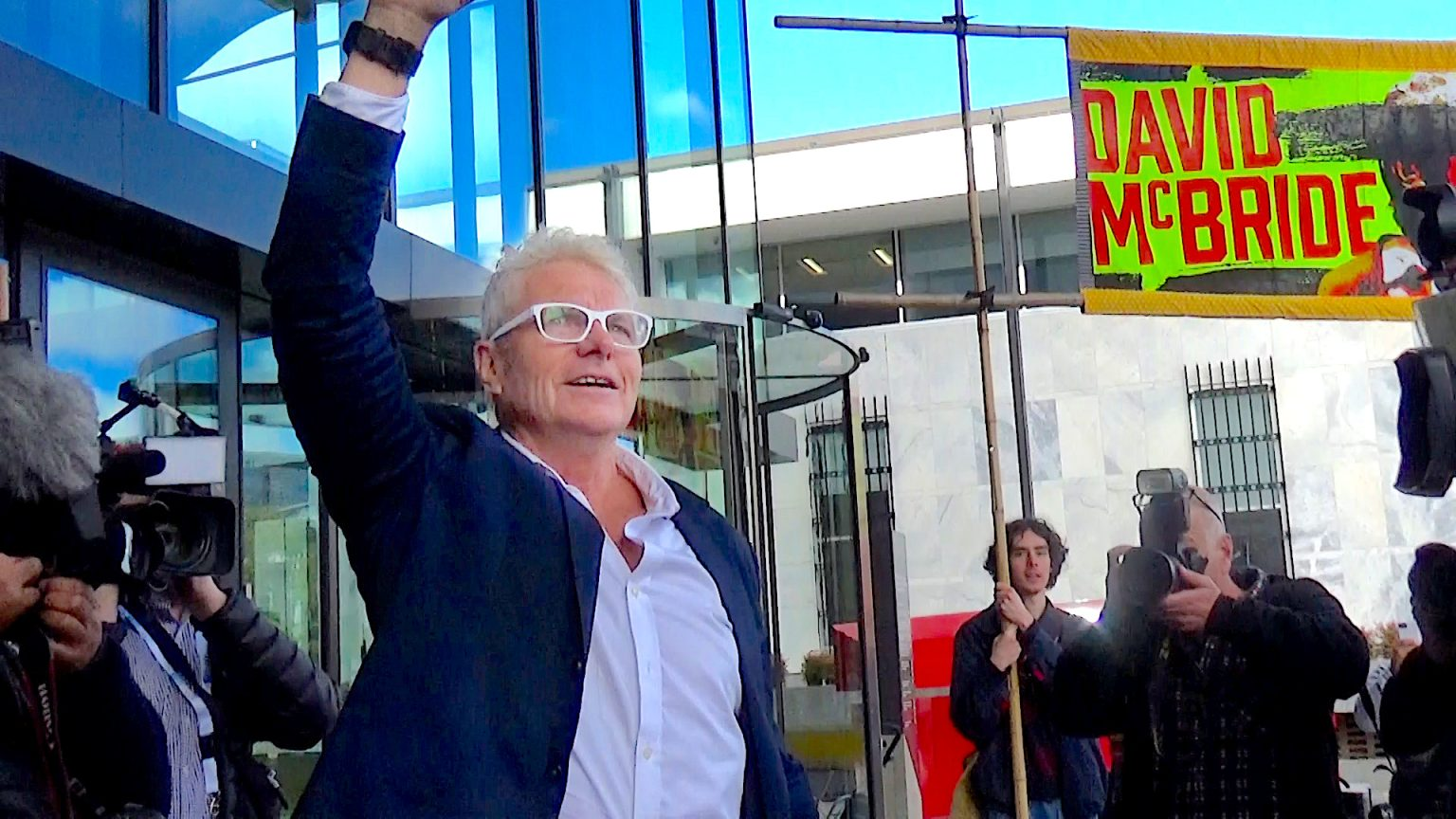
David McBride outside court in Canberra on May 7, 2024, after his sentencing hearing. (Cathy Vogan/Consortium News)

By The Sam Adams Associates for Integrity in Intelligence
The Sam Adams Associates for Integrity in Intelligence (S.A.A.I.I.) is honoured to announce that David McBride, the former Australian Army lawyer imprisoned after disclosing classified material that contributed to public reporting on alleged war crimes by Australian Special Forces in Afghanistan, will receive the 2026 Sam Adams Award for Integrity in Intelligence.
This Award, established in 2002 in memory of the late C.I.A. analyst Sam Adams, is presented annually to a member of the intelligence, military, or national security community who has demonstrated extraordinary courage, persistence, and devotion to truth regardless of personal cost.
Past recipients include Julian Assange, Coleen Rowley, Katharine Gun, Edward Snowden, Chelsea Manning, Daniel Ellsberg, and in 2025, Anthony Aguilar. They make up a larger body of honourees united by a shared willingness to sacrifice career and liberty in service of the public interest, rule of law and justice.
McBride’s selection as the S.A.A.I.I. Award recipient while incarcerated was followed by his release on parole in August 2026 after serving more than two years in an Australian federal prison, making him one of the very few S.A.A.I.I. honourees to be freed from incarceration shortly before, or in connection with, receiving the award.
Who Is David McBride?
David McBride was born in Sydney in 1963. He trained at the Royal Military Academy Sandhurst, served in the British Army and later studied law at the University of Sydney and Oxford before becoming a barrister working across criminal and civil jurisdictions in Australia.
In 2005 McBride was hired as a lawyer with the Australian Army Legal Corps in with Australian Special Forces unit. In his role as a military legal officer, McBride was deployed to Afghanistan twice, in 2011 and 2013.
During early 2013, McBride became alarmed by abrupt changes to the rules of engagement and a new approach to investigating soldiers. Where previously no soldiers had been investigated, every combat fatality was now treated as a potential murder, triggering criminal investigations even where there was no reasonable basis to suspect a crime had been committed.
[Read Consortium News‘ extensive coverage of the McBride case.]
McBride’s concern was not that soldiers should escape scrutiny, but that investigations must be based on evidence and conducted fairly, consistently and in accordance with the law. He was concerned that investigations only targeted lower level soldiers and not senior officers.
As an experienced lawyer and soldier, he recognised that something was wrong and made a formal complaint, questioning why the rules and the military’s approach to investigating soldiers had changed so dramatically. But when senior A.D.F. leadership dismissed his concerns, he began to suspect there was something much bigger going on. His attention turned to the conduct and decisions of those in charge.
The ‘Leak’ & the Afghan Files
Having failed to get answers through official channels, he turned to the media. McBride provided classified Defence documents to A.B.C. journalists Dan Oakes and Sam Clark in 2016.
In July 2017, the A.B.C. published the material as The Afghan Files, revealing that Australian special-forces personnel had allegedly killed unarmed men and children, executed a detainee, mutilated the bodies of combatants, and exposed a “code of silence” within the defence community that shielded perpetrators from accountability.
The reporting brought allegations of unlawful killings and other misconduct into public view and contributed to sustained scrutiny that preceded the later Afghanistan Inquiry.
The Brereton Inquiry: Independent Findings
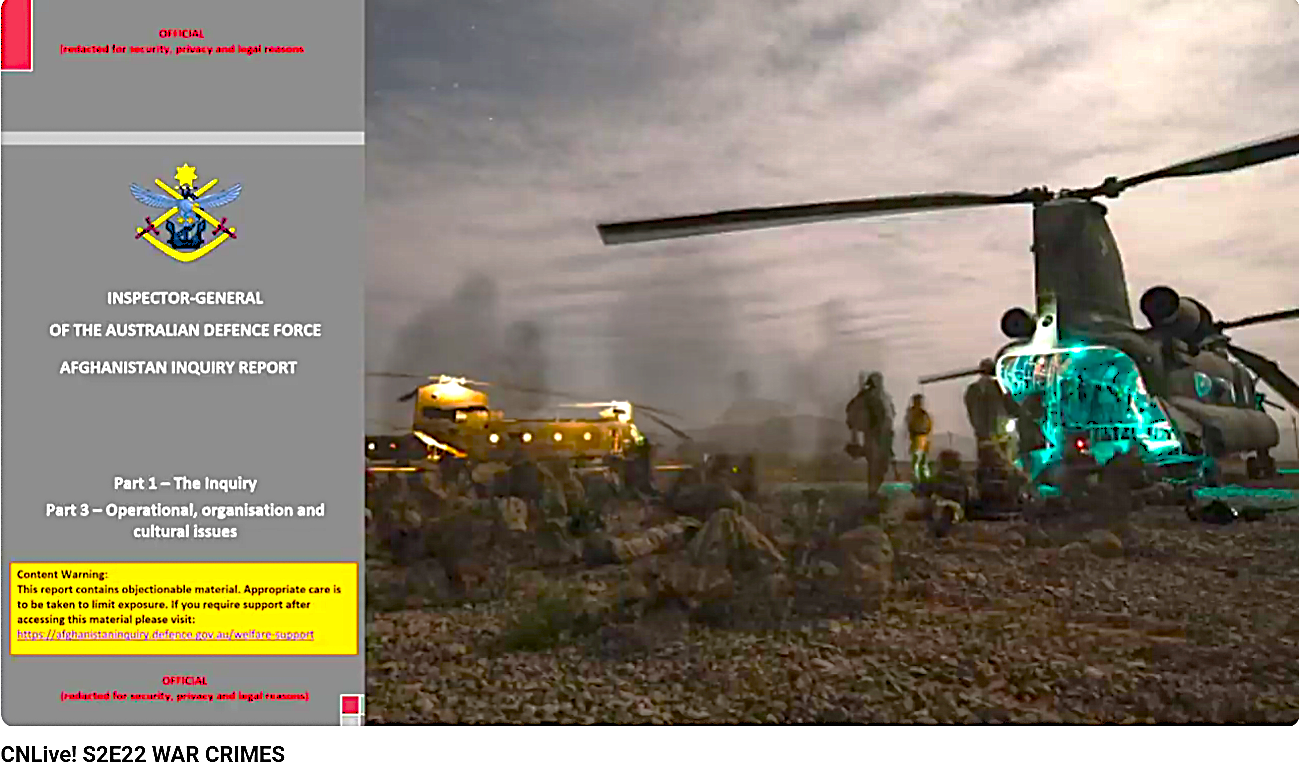
CNLive! webcast on the Brereton Report on Australian war crimes, Nov. 28, 2020. (Screenshot, CNLive!)
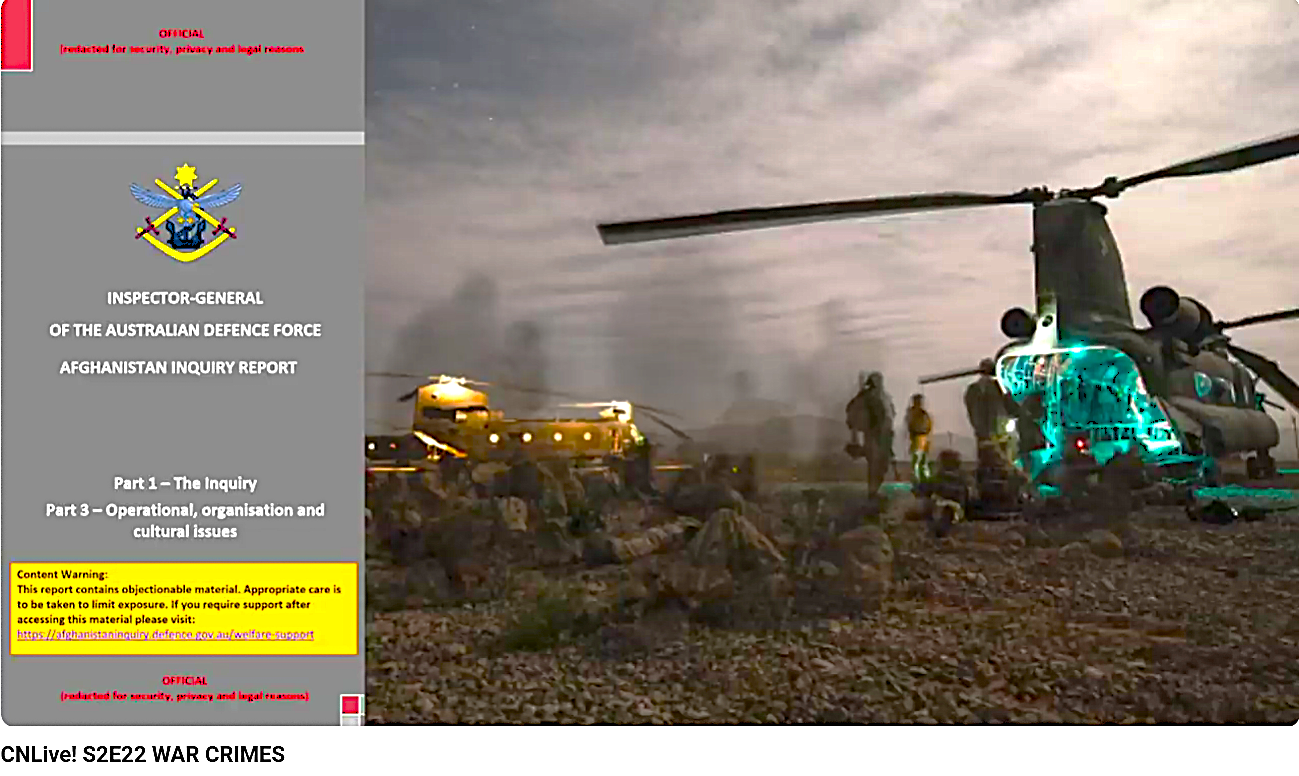
In November 2020, the Inspector-General of the Australian Defence Force released the findings of a four-year inquiry led by Justice Paul Brereton, commonly known as the ‘Brereton Report.’ The inquiry found credible information that Australian special-forces personnel unlawfully killed 39 Afghan civilians and prisoners across 23 incidents between 2009 and 2013, and cruelly mistreated two others, implicating 25 current or former A.D.F. members.
The report documented the practice of “throwdowns” or the planting of unauthorised weapons on victims’ bodies to fabricate legitimate-target narratives, and “blooding,” in which junior soldiers were reportedly ordered to kill prisoners to record their “first kill.”
Brereton called it,
“possibly the most disgraceful episode in Australia’s military history,”
and recommended that 36 matters involving 19 individuals be referred to the Australian Federal Police for potential prosecution. The later Inquiry independently found credible information of grave wrongdoing consistent with central concerns raised in The Afghan Files reporting.
Retaliation: Raids, Prosecution, and Imprisonment
Rather than protecting the whistleblower whose disclosures preceded official findings of credible information concerning alleged war crimes, the Australian government pursued McBride and the journalists who reported his material.
McBride himself was arrested at the Sydney Airport in September 2018 and charged with the theft of Commonwealth property and multiple counts of unlawfully disclosing Defence and Commonwealth information. In June 2019, the Australian Federal Police conducted an eight-hour raid on the A.B.C.’s Sydney headquarters, searching and copying material related to The Afghan Files reporting.
The operation was widely condemned as a serious threat to press freedom.
His defence team’s attempt to invoke Australian whistleblower protection laws was blocked when the government moved to prevent expert testimony from being heard on “national security grounds” and the presiding judge ruled that McBride was not legally bound to act in the “public interest” under his oath of service.
Facing a case stripped of its central defence, McBride pleaded guilty in November 2023, and on May 14, 2024, was sentenced by the ACT [Australian Capital Territory] Supreme Court by Justice David Mossop to five years and eight months in prison, with a non-parole period of two years and three months. His appeals against the severity of the sentence were rejected.
Notably, while McBride served real prison time, the Australian Federal Police ultimately declined to prosecute the A.B.C. journalist most central to the reporting, determining prosecution was not in the public interest and underscoring how the legal consequences of the affair fell disproportionately on the whistleblower rather than the press or the alleged perpetrators.
Of the 143 recommendations in the Brereton Report, and as of August 2026, no person has been convicted and sentenced for the alleged Afghanistan war crimes.
Release on Parole, 2026
McBride was granted parole by Attorney-General Michelle Rowland on Aug. 13, 2026 after serving his full non-parole period of 27 months at the Alexander Maconochie Centre in Canberra. Just prior to his release, he was diagnosed with lung cancer.
McBride, now 62, is receiving treatment and will serve the remaining roughly three years of his sentence under community supervision and strict conditions. Speaking to reporters upon his release, McBride said simply,
“I’m very happy to be out, it’s a beautiful day to be free.”
Later he described his incarceration as “a very positive experience.”
Why McBride Exemplifies the Sam Adams Award
McBride’s case distills the S.A.A.I.I.’s Award founding purpose into its starkest possible form. A person who tried every institutional channel available to him, was rebuffed at each turn, and ultimately paid with his liberty, health, and career for choosing conscience over compliance.
Several elements place him squarely within, and arguably at the extreme edge of, the tradition established by prior S.A.A.I.I. honourees such as Julian Assange, Katharine Gun, Thomas Drake, Daniel Ellsberg, and Chelsea Manning, each of whom exposed government wrongdoing, abuse of power, cover up and violations of the law at the cost of prosecution or persecution.
McBride is the only person known to have served a prison sentence in connection with the alleged Afghanistan war crimes and his sentence was for disclosure offences and not for committing war crimes. His disclosures were independently corroborated by an official government inquiry (the Brereton Report). The later Brereton Inquiry independently found credible information of grave wrongdoing consistent with central allegations brought to public attention through the A.B.C. reporting.
The Afghanistan Inquiry Implementation Oversight Panel stated in its final report that senior military leadership and top brass in the Australian Defence Force (A.D.F.) must be held accountable for command failures regarding the alleged murder of 39 Afghan prisoners and civilians.
The government’s response of raiding a national broadcaster’s newsroom, blocking whistleblower protection defences on national security grounds, and securing a multi-year prison sentence, produced a chilling effect widely described by journalists and legal observers as a “dark day” for Australian press freedom and democratic accountability.
The case of David McBride has become an internationally cited precedent in debates over whistleblower protections and the legal treatment of national security disclosures, drawing support from human rights lawyers, journalists, academics and civil society across Australia and around the world.
Sam Adams was a C.I.A. whistleblower who exposed the U.S. official lie about the strength of Viet Cong forces.