
Know all ye by these presents that Annie Machon is hereby honored with the traditional Sam Adams Corner-Brightener Candlestick Holder, in symbolic recognition of her courage in shining light into dark places.

“If you see something, say something.” Long before that saying came into vogue, Annie Machon took its essence to heart.
MI5, the British domestic intelligence agency, recognized how bright, enterprising, and unflappable Annie was and recruited her as soon as she completed her studies at Cambridge.
The good old boys in MI5 apparently thought she would have a malleable conscience, as well — such that she would have no qualms about secret monitoring of the very government officials overseeing MI5 itself, for example.
Annie would not be quiet about this secret abuse. Her partner, David Shayler, an MI5 colleague and — like Annie — a person of integrity and respect for law, became aware of an MI6 plan to assassinate Libyan leader Muammar Gaddafi.
They decided to blow the whistle and fled to France. (Many years later, a woman of high station but more flexible integrity openly gloated over Gaddafi’s brutal assassination.)
After three years on the lam, hiding mostly in France, they returned to the UK, where Annie was arrested (but never charged with a crime). The powers-that-be, however, chose to make an example of Shayler (not unlike what they are now doing to Julian Assange).
Shayler’s whistleblowing case dragged on for seven years, during which he did a brief stint in the infamous high-security prison where Julian Assange still rots (having been denied bail, yet again). A strong mitigation plea by Annie helped reduce Shayler’s remaining prison time. All in all, though, what he was forced to endure took a hard toll on him.
More broadly, the issues that surfaced around whistleblowing at the time remain largely the same two decades later. Annie Machon has been a very prominent and strong supporter of Julian. She has also been a much admired mentor to less experienced women and men as they seek to become better informed on issues of integrity and courage, and take Annie up on her offer to “help them meet interesting people”, as she puts it.
We would be remiss today were we not to call to mind the courageous example of our first two awardees, Coleen Rowley (FBI) and Katharine Gun (GCHQ), who took great risks in exposing malfeasance and in trying to head off the attack on Iraq. And, as Julian Assange did when he won this award, we again honor his treasured source, Chelsea Manning, for her continuing courage and scarcely believable integrity.
Ed Snowden, our Sam Adams awardee in 2013, noted that we tend to ignore some degree of evil in our daily life, but, as Ed put it, “We also have a breaking point and when people find that, they act.”
Annie is still acting, as one can see as this World Ethical Data Forum unfolds.
Presented this 17th day of March at the World Ethical Data Forum by admirers of the example set by the late CIA analyst, Sam Adams.
Related Articles
Russia-Baiting and Risks of Nuclear War
Exclusive: The propaganda war on Russia is spinning out of control with a biased investigation blaming Moscow for the MH-17 tragedy and angry exchanges over Syria, raising the risks of nuclear war, says ex-CIA analyst Ray McGovern. (Originally published Sept 30, 2016 on Consortiumnews.com)
By Ray McGovern
As U.S. and Russian officials trade barbed threats and as diplomacy on Syria is “on the verge” of extinction, it is tempting to view the ongoing propaganda exchange over who shot down Malaysia Airlines Flight 17 in July 2014 as a side-show. That would be a huge mistake – easily made by President Obama’s wet-behind-the-ears sophomoric advisers who seem to know very little of the history of U.S.-Russia relations and appear smug in their ignorance.
Adult input is sorely needed. There are advantages to having some hands-on experience, and having watched how propaganda wars can easily escalate to military confrontation. In a Sept. 28 interview with Sputnik Radio, I addressed some serious implications of the decision by the U.S. and two of its European vassal states (the Netherlands and Ukraine) to stoke tensions with Russia still higher by blaming it for the downing of MH-17.
Sergey V. Lavrov, Minister for Foreign Affairs of the Russian Federation, addresses the general debate of the General Assembly’s seventy-first session. 23 September 2016 (UN Photo)
Sergey V. Lavrov, Minister for Foreign Affairs of the Russian Federation, addresses the general debate of the General Assembly’s seventy-first session.
Sept. 23, 2016 (UN Photo)
In short, there is considerable risk that the Russians may see this particular propaganda offensive (which “justified” the European Union’s economic sanctions in 2014), together with NATO’s saber rattling in central Europe, as steps toward war. In fact, there is troubling precedent for precisely that.
A very similar set of circumstances existed 33 years ago after the Soviets did shoot down Korean Airlines Flight 007 on Sept. 1, 1983, when it strayed over sensitive military targets inside the Soviet Union and the KAL-007 pilots failed to respond to repeated warnings. After the tragic reality became obvious, the Soviets acknowledged that they had downed the plane but said they did not know it was a passenger plane.
However, 1983 was another time of high tensions between the two superpowers and President Ronald Reagan wanted to paint the Soviets in the darkest of hues. So, his administration set out to sell the storyline that the Soviets had willfully murdered the 269 passengers and crew.
U.S. government propagandists and their media stenographers laid on all the Sturm und Drang they could summon to promote the lie that the Soviets knew KAL-007 was a civilian passenger plane before they shot it down. As Newsweek’s headline declared, “Murder in the Sky.”
Exploitation of the tragedy yielded a steep rise in tensions, and almost led to a nuclear exchange just two months later. There is an important lesson, now three decades later, as Western governments and the mainstream media manufacture more endless fear and hatred of Russia.
The Dutch/Ukrainian Follies
On Wednesday, new “evidence” blaming Russia for the downing of MH-17 over eastern Ukraine was made public – brought out of the oven, as it were, at a Dutch Maid bakery employing Ukrainian confectioners. A bite into the evidence and it immediately dissolves like refined sugar – and leaves an unpleasant artificial taste in the mouth.
The Dutch Safety Board’s reconstruction of where it believed the missile exploded near Malaysia Airlines Flight 17 on July 17, 2014.
The Dutch Safety Board’s reconstruction of where it believed the missile exploded near Malaysia Airlines Flight 17 on July 17, 2014.
The Dutch-Ukrainian charade played by the “Joint Investigation Team,” on which Belgium, Australia and Malaysia also have members, is an insult to the relatives and friends of the 298 human beings killed in the shoot-down. Understandably, those relatives and friends long for truth and accountability, and they deserve it.
Yet, as happened in 1983 with the credulous acceptance of the Reagan administration’s version of the KAL-007 case, the mainstream Western media has embraced the JIT’s findings as “conclusive” and the evidence as “overwhelming.” But it is in reality extraordinarily thin, essentially a case of deciding immediately after the event that the Russians were to be blamed and spending more than two years assembling snippets of intercepted conversations (from 150,000 provided by the Ukrainian intelligence service) that could be stitched together to create an impression of guilt.
In the slick video, which serves as the JIT’s investigative “report,” the intercepted voices don’t say anything about Russian Buk missiles actually being deployed inside Ukraine or shooting down a plane or the need to get the Buk missiles out of Ukraine afterwards. One voice early on says he’d like to have some Buks but – after that – Buks aren’t mentioned and everything in the video is supposition. [See Consortiumnews.com’s “Troubling Gaps in MH-17 Report.”]
There’s also no explanation as to why the Russians would have taken a bizarrely circuitous route when a much more direct and discreet course was available. The JIT’s embrace of that strange itinerary was made necessary by the fact that the only “social media” images of a Buk system traveling on July 17, 2014, before the MH-17 shoot-down, show the Buks heading east toward Russia, not west from Russia. [See Consortiumnews.com’s “The Official and Implausible MH-17 Scenario.”]
In other words, to make the storyline fit with the available images, the JIT had to take the alleged Russian-Buk convoy on a ridiculous trip far out of the way so it could be photographed in Donetsk before doubling back toward the alleged firing site near Snizhne, which could have been reached easily from the Russian border without the extensive detour through heavily populated areas.
Ignoring Inconvenient Evidence
The JIT also had to ignore its own evidence that on the night of July 16-17, 2014, Ukrainian military convoys were pressing deep inside what has been called “rebel-controlled territory.” The obvious implication is that if a Ukrainian convoy could move to within a few miles of Luhansk, as one of the intercepts described, a Ukrainian Buk convoy could have traveled to the east as well.
And, the JIT’s presumed motive for the Russians taking the extraordinary decision of supplying a Buk battery to the rebels – that it was needed to shoot down Ukrainian warplanes attacking rebels on the front lines – doesn’t fit with the placement of a Buk system on farmland south of Snizhne, far from the frontlines. Indeed, very little about the JIT’s case makes sense.
It also appears that the JIT devoted no effort to examining other plausible scenarios regarding who might have shot down MH-17. The JIT video report makes no reference to the several Ukrainian Buk systems that were operating in eastern Ukraine on the day that MH-17 was shot down.
The Dutch intelligence service MIVD, relying on NATO’s intelligence capabilities, reported earlier that the only anti-aircraft-missile systems in the area on July 17, 2014, capable of shooting down MH-17 were under the control of the Ukrainian military.
But the JIT’s report offered no explanation of where those Ukrainian Buk systems were located or whether Ukraine had accounted for all the Buk missiles in those batteries. The JIT’s blinders can be explained by the fact that it was coordinating with (and relying on) Ukraine’s SBU intelligence agency, which has among its responsibilities the protection of Ukrainian government secrets.
The shocking reality about the JIT is that one of the major suspects for having shot down MH-17, Ukraine, was pretty much running the inquiry.
Yet, since the JIT’s accusations on Wednesday, the West’s mainstream media has put on its own blinders so as not to notice the gaps and inconsistencies in the case. But what should be apparent to anyone without blinders is that the JIT set its sights on blaming the Russians for the MH-17 shoot-down in 2014 and nothing was going to get in the way of that conclusion.
That predetermined conclusion began with Secretary of State John Kerry’s rush to judgment, just three days after the shoot-down, putting the blame on the Russians. It then took the JIT more than two years to scrape together enough “evidence” to “confirm” Kerry’s findings.
The Near-Nuclear Clash
As a longtime CIA analyst covering the Soviet Union, the MH-17 case immediately brought to my mind the exploitation of the KAL-007 tragedy for propaganda purposes in 1983. After KAL-007 went down, the U.S. propaganda machinery, led by the U.S. Information Agency, went into high gear, even doctoring evidence for a U.N. Security Council meeting to “prove” the Soviets knew KAL-007 was a civilian aircraft and still shot it down deliberately.
“Barbaric” was the word used then – and in recent days U.S. Ambassador to the U.N. Samantha Power has applied that epithet again to the leaders in the Kremlin.
The same sort of anti-Russian hysteria is in play today as it was in 1983. And we now know based on declassified records that the extreme vilification of Moscow back then led Soviet leaders to believe that President Reagan was preparing for a nuclear war, a conflict that almost got started because of the harsh propaganda, combined with unprecedented military exercises and other provocations.
Last year, a former CIA colleague and senior manager of Soviet analysis, Mel Goodman, wrote about the “war scare” in the Kremlin in the fall of 1983, and asked if history may be repeating itself. Goodman personally helped persuade Reagan to ratchet down the tension, but it’s less clear if any adult remains who could tell President Obama to do the same now.
Goodman wrote: “1983 was the most dangerous year in the Soviet-American Cold War confrontation since the 1962 Cuban missile crisis. President Reagan declared a political and military campaign against the ‘evil empire’ … Soviet leaders believed that the ‘correlation of world forces,’ Soviet terminology for the international balance, was unfavorable to Moscow and that the U.S. government was in the hands of a dangerous anti-Soviet crowd.
“In response to Reagan’s references to the Soviet Union as the ‘focus of evil in the world’ … the new Soviet general secretary, Yuri Andropov, a former KGB chief, suggested that Reagan was insane and a liar … Andropov would take no chances. Soviet leaders believed the Reagan administration was using a mobilization exercise called ‘Able Archer’ in November 1983 to prepare a nuclear surprise attack. The KGB instituted a sensitive collection effort to determine if the United States was planning such an attack. …
“In addition to the Able Archer mobilization exercise that alarmed the Kremlin, the Reagan administration authorized unusually aggressive military exercises near the Soviet border that, in some cases, violated Soviet territorial sovereignty. The Pentagon’s risky measures included … naval exercises in wartime approaches to the USSR where U.S. warships had previously not entered. Additional secret operations simulated surprise naval attacks on Soviet targets.”
Reining in Reagan
Goodman continued: “One of the great similarities between Russia and the United States was that both sides feared surprise attack. The United States suffered psychologically from the Japanese attack at Pearl Harbor; it has still not recovered from 9/11. Yet, the United States has never appreciated that Moscow has similar fears due to Operation Barbarossa, the German invasion in the same year as Pearl Harbor, a far greater nightmare.
President Ronald Reagan with Secretary of State Alexander Haig and National Security Advisor Richard Allen during a meeting with Interagency Working Committee on Terrorism in the Cabinet Room on Jan. 26, 1981. (Photo from Reagan Library archives)
President Ronald Reagan with Secretary of State Alexander Haig and National Security Advisor Richard Allen during a meeting with Interagency Working Committee on Terrorism in the Cabinet Room on Jan. 26, 1981. (Photo from Reagan Library archives)
“Russia’s fear of surprise attack was accentuated in 1983, when the United States deployed the Army’s Pershing-II missile and land-based cruise missiles in West Europe as a counter to the Soviet Union’s SS-20 missiles. The SS-20 was not a ‘strategic’ weapon because of a limited range (3,000 miles) well short of the United States. The P-II, however, could not only reach the Soviet Union, but it could destroy Moscow’s command and control systems with incredible accuracy. Since the Soviets would have limited warning time – less than five minutes – the P-II was viewed as a first-strike weapon that could destroy the Soviet early warning system.
“In addition to the huge strategic advantage from the deployment of P-II and numerous cruise missiles, the U.S. deployment of the MX missile and the D-5 Trident submarine placed the Soviets in an inferior position with regard to strategic modernization. Overall, the United States held a huge strategic advantage in political, economic, and military policy.
“The Pentagon’s psychological warfare program to intimidate the Kremlin, including dangerous probes of Soviet borders by the Navy and Air Force, was unknown to CIA analysts. Thus, the CIA was at a disadvantage in trying to analyze the war scare because the Pentagon refused to share information on military maneuvers and weapons deployments.
“In 1983, the CIA had no idea that the annual Able Archer exercise would be conducted in a provocative fashion with high-level participation. The exercise was a test of U.S. command and communications procedures, including procedures for the release and use of nuclear weapons in case of war.”
Goodman continued: “I believed that Soviet fears were genuine and Reagan’s national security advisor, Robert McFarlane, was even known to remark, ‘We got their attention’ but ‘maybe we overdid it.’ … [CIA Director William] Casey took our analysis to the White House, and Reagan made sure that the exercises were toned down.
“For the first time, the Able Archer exercise was going to include President Reagan, Vice President Bush, and Secretary of Defense Weinberger, but when the White House understood the extent of Soviet anxiety regarding U.S. intentions, the major principals bowed out. … Soviet military doctrine had long held that a possible U.S. modus operandi for launching an attack on the USSR would be to convert an exercise into the real thing.
“Three decades later, history seems to be repeating itself. Washington and Moscow are once again exchanging ugly broadsides over the confrontations in Ukraine and Syria. The Russian-American arms control and disarmament dialogue has been pushed to the background, and the possibilities of superpower conflict into the foreground. Pentagon briefers are using the language of the Cold War in their congressional briefings, referring to Putin’s Russia as an ‘existential threat.’”
(END of excerpts from Mel Goodman’s account of “Able Archer.”)
The KAL-007 Prequel
As I wrote after the MH-17 shoot-down in 2014:
The death of all 298 people onboard the Malaysia Airline flight, going from Amsterdam to Kuala Lumpur, will surely provide plenty of fuel for the already roaring anti-Russian propaganda machine. Still, the U.S. press might pause to recall how it’s been manipulated by the U.S. government in the past, including three decades ago by the Reagan administration twisting the facts of the KAL-007 tragedy.
In that case, a Soviet fighter jet shot down a Korean Air Line plane on Sept. 1, 1983, after it strayed hundreds of miles off course and penetrated some of the Soviet Union’s most sensitive airspace over military facilities in Kamchatka and Sakhalin Island.
Over Sakhalin, KAL-007 was finally intercepted by a Soviet Sukhoi-15 fighter. The Soviet pilot tried to signal the plane to land, but the KAL pilots did not respond to the repeated warnings. Amid confusion about the plane’s identity — a U.S. spy plane had been in the vicinity hours earlier — Soviet ground control ordered the pilot to fire. He did, blasting the plane out of the sky and killing all 269 people on board.
The Soviets soon realized they had made a horrendous mistake. U.S. intelligence also knew from sensitive intercepts that the tragedy had resulted from a blunder, not from a willful act of murder (much as on July 3, 1988, the USS Vincennes fired a missile that brought down an Iranian civilian airliner in the Persian Gulf, killing 290 people, an act which President Ronald Reagan explained as an “understandable accident”).
But a Soviet admission of a tragic blunder regarding KAL-007 wasn’t good enough for the Reagan administration, which saw the incident as a propaganda windfall. At the time, the felt imperative in Washington was to blacken the Soviet Union in the cause of Cold War propaganda and to escalate tensions with Moscow.
To make the blackest case against Moscow, the Reagan administration suppressed exculpatory evidence from the U.S. electronic intercepts. The U.S. mantra became “the deliberate downing of a civilian passenger plane.” Newsweek ran a cover emblazoned with the headline “Murder in the Sky.”
“The Reagan administration’s spin machine began cranking up,” wrote Alvin A. Snyder, then-director of the U.S. Information Agency’s television and film division, in his 1995 book, Warriors of Disinformation.
USIA Director Charles Z. Wick “ordered his top agency aides to form a special task force to devise ways of playing the story overseas. The objective, quite simply, was to heap as much abuse on the Soviet Union as possible,” Snyder recalled.
Snyder noted that “the American media swallowed the U.S. government line without reservation.” Said the venerable Ted Koppel on the ABC News ‘Nightline’ program: ‘This has been one of those occasions when there is very little difference between what is churned out by the U.S. government propaganda organs and by the commercial broadcasting networks.’”
On Sept. 6, 1983, the Reagan administration went so far as to present a doctored transcript of the intercepts to the United Nations Security Council. …
“The tape was supposed to run 50 minutes,” Snyder said about the recorded Soviet intercepts. “But the tape segment we [at USIA] had ran only eight minutes and 32 seconds. … ‘Do I detect the fine hand of [Richard Nixon’s secretary] Rosemary Woods here?’ I [Snyder] asked sarcastically.’”
But Snyder had a job to do: producing the video that his superiors wanted. “The perception we wanted to convey was that the Soviet Union had cold-bloodedly carried out a barbaric act,” Snyder wrote.
Seeing the Whole Story
Only a decade later, when Snyder saw the complete transcripts — including the portions that the Reagan administration had hidden — would he fully realize how many of the central elements of the U.S. presentation were false.
Russian President Vladimir Putin after the military parade on Red Square, May 9, 2016 Moscow. (Photo from: http://en.kremlin.ru)
Russian President Vladimir Putin after the military parade on Red Square, May 9, 2016 Moscow. (Photo from: http://en.kremlin.ru)
The Soviet fighter pilot apparently did believe he was pursuing a U.S. spy plane, according to the intercepts, and he was having trouble in the dark identifying the plane. At the instructions of Soviet ground controllers, the pilot had circled the KAL airliner and tilted his wings to force the aircraft down. The pilot said he fired warning shots, too. “This comment was also not on the tape we were provided,” Snyder wrote.
It was clear to Snyder that in the pursuit of its Cold War aims, the Reagan administration had presented false accusations to the United Nations, as well as to the people of the United States and the world. To Reagan’s people, the ends of smearing the Soviets had justified the means of falsifying the historical record.
In his book, Snyder acknowledged his role in the deception and drew an ironic lesson from the incident. The senior USIA official wrote, “The moral of the story is that all governments, including our own, lie when it suits their purposes. The key is to lie first.”
[End of my excerpt]
In 2016, as we deal with the West’s new hysteria regarding Russia – complete with rehashes of prior propaganda themes and military escalations – the pressing question is whether there are any adults left at senior levels of Official Washington who can rein in the madness before things spin entirely out of control.
Santayana famously noted, “Those who cannot remember the past are condemned to repeat it.” But the real danger now is that history won’t stop at repeating itself but will continue beyond, plunging over the nuclear precipice.
Ray McGovern 27-year career as a CIA analyst included leading CIA’s Soviet Foreign Policy Branch. He later conducted morning briefings of President Reagan’s most senior national security advisers with the President’s Daily Brief. He now works with Tell the Word, a publishing arm of the ecumenical Church of the Saviour in inner-city Washington.
VIPS: Obama Warned to Defuse Tensions with Russia
A group of ex-U.S. intelligence officials is warning President Obama to defuse growing tensions with Russia over Syria by reining in the demonization of President Putin and asserting White House civilian control over the Pentagon. (Originally published on Oct 2, 2016 on Consortiumnews.com)
ALERT MEMORANDUM FOR: The President
FROM: Veteran Intelligence Professionals for Sanity
SUBJECT: PREVENTING STILL WORSE IN SYRIA
We write to alert you, as we did President George W. Bush, six weeks before the attack on Iraq, that the consequences of limiting your circle of advisers to a small, relatively inexperienced coterie with a dubious record for wisdom can prove disastrous.* Our concern this time regards Syria.
We are hoping that your President’s Daily Brief tomorrow will give appropriate attention to Saturday’s warning by Russia’s Foreign Ministry spokesperson Maria Zakharova: “If the US launches a direct aggression against Damascus and the Syrian Army, it would cause a terrible, tectonic shift not only in the country, but in the entire region.”
Speaking on Russian TV, she warned of those whose “logic is ‘why do we need diplomacy’ … when there is power … and methods of resolving a problem by power. We already know this logic; there is nothing new about it. It usually ends with one thing – full-scale war.”
We are also hoping that this is not the first you have heard of this – no doubt officially approved – statement. If on Sundays you rely on the “mainstream” press, you may well have missed it. In the Washington Post, an abridged report of Zakharova’s remarks (nothing about “full-scale war”) was buried in the last paragraph of an 11-paragraph article titled “Hospital in Aleppo is hit again by bombs.” Sunday’s New York Times totally ignored the Foreign Ministry spokesperson’s statements.
In our view, it would be a huge mistake to allow your national security advisers to follow the example of the Post and Times in minimizing the importance of Zakharova’s remarks.
Events over the past several weeks have led Russian officials to distrust Secretary of State John Kerry. Indeed, Foreign Minister Sergey Lavrov, who parses his words carefully, has publicly expressed that distrust. Some Russian officials suspect that Kerry has been playing a double game; others believe that, however much he may strive for progress through diplomacy, he cannot deliver on his commitments because the Pentagon undercuts him every time. We believe that this lack of trust is a challenge that must be overcome and that, at this point, only you can accomplish this.
It should not be attributed to paranoia on the Russians’ part that they suspect the Sept. 17 U.S. and Australian air attacks on Syrian army troops that killed 62 and wounded 100 was no “mistake,” but rather a deliberate attempt to scuttle the partial cease-fire Kerry and Lavrov had agreed on – with your approval and that of President Putin – that took effect just five days earlier.
In public remarks bordering on the insubordinate, senior Pentagon officials showed unusually open skepticism regarding key aspects of the Kerry-Lavrov deal. We can assume that what Lavrov has told his boss in private is close to his uncharacteristically blunt words on Russian NTV on Sept. 26:
“My good friend John Kerry … is under fierce criticism from the US military machine. Despite the fact that, as always, [they] made assurances that the US Commander in Chief, President Barack Obama, supported him in his contacts with Russia (he confirmed that during his meeting with President Vladimir Putin), apparently the military does not really listen to the Commander in Chief.”
Lavrov’s words are not mere rhetoric. He also criticized JCS Chairman Joseph Dunford for telling Congress that he opposed sharing intelligence with Russia, “after the agreements concluded on direct orders of Russian President Vladimir Putin and US President Barack Obama stipulated that they would share intelligence. … It is difficult to work with such partners. …”
Policy differences between the White House and the Pentagon are rarely as openly expressed as they are now over policy on Syria. We suggest you get hold of a new book to be released this week titled The General vs. the President: MacArthur and Truman at the Brink of Nuclear War by master historian H. W. Brands. It includes testimony, earlier redacted, that sheds light on why President Truman dismissed WWII hero Gen. Douglas MacArthur from command of U.N. forces in Korea in April 1951. One early reviewer notes that “Brands’s narrative makes us wonder about challenges of military versus civilian leadership we still face today.” You may find this new book more relevant at this point in time than the Team of Rivals.
The door to further negotiations remains ajar. In recent days, officials of the Russian foreign and defense ministries, as well as President Putin’s spokesman, have carefully avoided shutting that door, and we find it a good sign that Secretary Kerry has been on the phone with Foreign Minister Lavrov. And the Russians have also emphasized Moscow’s continued willingness to honor previous agreements on Syria.
In the Kremlin’s view, Russia has far more skin in the game than the U.S. does. Thousands of Russian dissident terrorists have found their way to Syria, where they obtain weapons, funding, and practical experience in waging violent insurgency. There is understandable worry on Moscow’s part over the threat they will pose when they come back home. In addition, President Putin can be assumed to be under the same kind of pressure you face from the military to order it to try to clean out the mess in Syria “once and for all,” regardless how dim the prospects for a military solution are for either side in Syria.
We are aware that many in Congress and the “mainstream” media are now calling on you to up the ante and respond – overtly or covertly or both – with more violence in Syria. Shades of the “Washington Playbook,” about which you spoke derisively in interviews with the Atlantic’s Jeffrey Goldberg earlier this year. We take some encouragement in your acknowledgment to Goldberg that the “playbook” can be “a trap that can lead to bad decisions” – not to mention doing “stupid stuff.”
Goldberg wrote that you felt the Pentagon had “jammed” you on the troop surge for Afghanistan seven years ago and that the same thing almost happened three years ago on Syria, before President Putin persuaded Syria to surrender its chemical weapons for destruction. It seems that the kind of approach that worked then should be tried now, as well – particularly if you are starting to feel jammed once again.
Incidentally, it would be helpful toward that end if you had one of your staffers tell the “mainstream” media to tone down it puerile, nasty – and for the most part unjustified and certainly unhelpful – personal vilification of President Putin.
Renewing direct dialogue with President Putin might well offer the best chance to ensure an end, finally, to unwanted “jamming.” We believe John Kerry is correct in emphasizing how frightfully complicated the disarray in Syria is amid the various vying interests and factions. At the same time, he has already done much of the necessary spadework and has found Lavrov for the most part, a helpful partner.
The Security Council adopted resolution 2310 (2016) urging all States that have either not signed or not ratified the Comprehensive Nuclear-Test-Ban Treaty (CTBT) to do so without further delay. The Council also called upon all States to refrain from conducting any nuclear-weapon test explosion or any other nuclear explosion and to maintain their moratoria in this regard. The resolution was adopted with a vote of 14 in favour, and one abstention (Egypt).
Still, in view of lingering Russian – and not only Russian – skepticism regarding the strength of your support for your secretary of state, we believe that discussions at the highest level would be the best way to prevent hotheads on either side from risking the kind of armed confrontation that nobody should want.
Therefore, we strongly recommend that you invite President Putin to meet with you in a mutually convenient place, in order to try to sort things out and prevent still worse for the people of Syria.
In the wake of the carnage of World War II, Winston Churchill made an observation that is equally applicable to our 21st Century: “To jaw, jaw, jaw, is better than to war, war, war.”
* In a Memorandum to President Bush criticizing Colin Powell’s address to the UN earlier on February 5, 2003, VIPS ended with these words: “After watching Secretary Powell today, we are convinced that you would be well served if you widened the discussion … beyond the circle of those advisers clearly bent on a war for which we see no compelling reason and from which we believe the unintended consequences are likely to be catastrophic.”
For the Steering Group, Veteran Intelligence Professionals for Sanity
William Binney, former Technical Director, World Geopolitical & Military Analysis, NSA; co-founder, SIGINT Automation Research Center (ret.)
Fred Costello, Former Russian Linguist, USAF
Mike Gravel, former Adjutant, top secret control officer, Communications Intelligence Service; special agent of the Counter Intelligence Corps and former United States Senator
Matthew Hoh, former Capt., USMC, Iraq & Foreign Service Officer, Afghanistan (associate VIPS)
Larry C. Johnson, CIA & State Department (ret.)
John Kiriakou, former CIA counterterrorism officer and former senior investigator, Senate Foreign Relations Committee
Linda Lewis, WMD preparedness policy analyst, USDA (ret.) (associate VIPS)
Edward Loomis, NSA, Cryptologic Computer Scientist (ret.)
Ray McGovern, former US Army infantry/intelligence officer & CIA analyst (ret.)
Elizabeth Murray, Deputy National Intelligence Officer for Middle East, CIA (ret.)
Todd Pierce, MAJ, US Army Judge Advocate (ret.)
Coleen Rowley, Division Counsel & Special Agent, FBI (ret.)
Kirk Wiebe, former Senior Analyst, SIGINT Automation Research Center, NSA, (ret.)
Robert Wing, former Foreign Service Officer (associate VIPS)
Ann Wright, U.S. Army Reserve Colonel (ret) and former U.S. Diplomat
CIA Whistleblower Kiriakou Honored for Integrity
The U.S. government gives free passes to officials who commit war crimes but imprisons whistleblowers who tell the truth, a fate that befell CIA’s John Kiriakou for disclosing torture. But he was honored by some ex-intelligence officers, reports Ray McGovern.
By Ray McGovern
Former CIA official John Kiriakou, who spent two years in prison for revealing the truth about White House-sanctioned torture, became the 15th recipient of the Sam Adams Award for Integrity at a ceremony at America University.
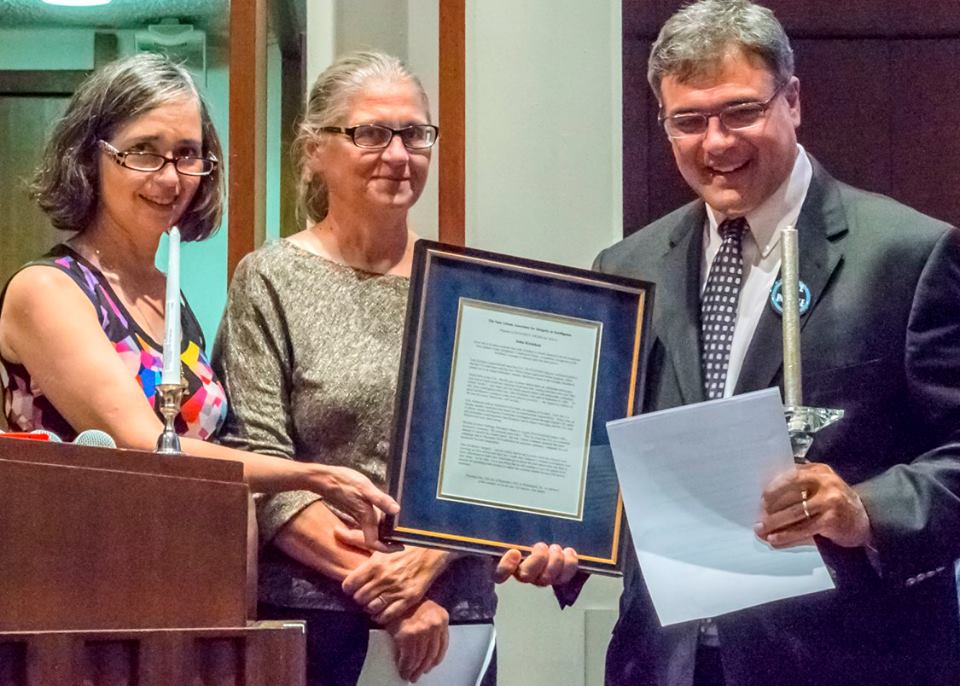
Last year, PEN Center USA, a human rights and freedom of expression organization, honored John Kiriakou, with its “First Amendment” award. It has since become clear that while John Kiriakou sat in prison, Senate Intelligence Committee investigators were uncovering heinous details about torture by the CIA from its own original banality-of-evil cables, which showed that CIA and others had lied in claiming torture “worked.”
President Barack Obama chose to add his weight to a remarkably brazen effort to cover it all up and scuttle the Senate report. To her credit, committee chair Dianne Feinstein, with support from then-Senate Majority Leader Harry Reid and committee members Mark Udall and Ron Wyden (all Democrats) faced President Obama down.
This scarcely believable fact – missed somehow by the “mainstream” media – is woven into the citation presented to Kiriakou on Sunday:
The Sam Adams Associates for Integrity in Intelligence presents its INTEGRITY AWARD for 2016 to John Kiriakou Know all ye by these presents that John Kiriakou is hereby honored with the traditional Sam Adams Corner-Brightener Candlestick Holder, in symbolic recognition of Mr. Kiriakou’s courage in shining light into dark places.
John Kiriakou found himself atop the CIA’s WANTED list when he confirmed publicly that the CIA had been carrying out a White House-approved torture program, which turned out to be using techniques virtually identical to those in the Gestapo Handbuch.
Alarm bells at the CIA. Put this guy in prison before there are additional disclosures. And seduce Hollywood into seducing Americans into “seeing with their own eyes” that torture “works.” And make sure the media ignores others with impeccable credentials, like Army Intelligence chief Gen. John Kimmons, who said on September 6, 2006: “No good intelligence is going to come from abusive practices. … the empirical evidence of the last five years, hard years, tells us that.”
Gen. Kimmons had an institution at his back, not nipping at his heels. Enter the U.S. Senate, another institution that faced into its constitutional responsibility. While John sat in prison, Senate Intelligence Committee investigators pored through original CIA cables and concluded unambiguously that Kimmons and Kiriakou were right, and the CIA (and Hollywood) were dead wrong.
Briefed on those findings, President Obama in August 2014 trivialized torture with a dismissive comment, “We tortured some folks.” Then he joined the CIA in a concerted attempt to squelch the Senate report. But Sen. Dianne Feinstein thwarted that joint campaign and in December 2014 published an executive summary – redacted, but still gruesome beyond imagination.
John Kiriakou’s integrity – and the reality that he sat in prison while the torturers were covering up their actions and their lies – made Sen. Feinstein’s intrepid investigators even more determined to make sure Americans got to know the truth about what was done in their name. As for John, it is a sure thing that he will continue to give no quarter in his passion for spreading truth around, no matter the systemic hurdles he may still have to surmount.
Presented this 25th day of September 2016 in Washington, DC, by admirers of the example set by the late CIA analyst, Sam Adams.
++++++++++++++++++++++++++
Sam Adams’s painstaking analysis in 1966/1967 revealed there were twice as many Vietnamese Communists under arms in South Vietnam as Gen. William Westmoreland would admit to. The issue became a David-v-Goliath bureaucratic struggle, with CIA analysts unable to prevail against the Army (and the White House). Adams continued to press for honesty and accountability but stayed “inside channels” – and failed. He died at 55 of a sudden heart attack, with profound remorse. He could not rid himself of the belief that, had he not let himself be diddled – had he, in other words, gone to the media – hundreds of thousands of lives might have been saved. His story is told in War of Numbers, published posthumously.
Previous recipients of the Sam Adams Award are:
Coleen Rowley (FBI), Katharine Gun (UK-GCHQ), Sibel Edmonds (FBI), Amb. Craig Murray (UK Foreign Office), Frank Grevil (Major, Danish Military Intelligence)**, Sam Provance (Sgt. US Army, Abu Ghraib), Larry Wilkerson (Col. US Army, Chief of Staff to Secretary of State), Julian Assange (WikiLeaks),** Jesselyn Radack (Department of Justice), Thomas Drake (NSA), Thomas Fingar (Assistant Secretary of State for Intelligence), Edward Snowden (NSA),** Chelsea (Bradley) Manning (PFC, US Army),** William Binney (NSA), John Kiriakou (CIA)**
* In bold = Names of former awardees who spoke at Kiriakou award ceremony
** = Earlier awardees imprisoned, confined, exiled for speaking truth
(Originally published at Consortiumnews.com and authored by Ray McGovern, who like Sam Adams, began a career as a CIA analyst under President Kennedy; working on Vietnam, they became close associates. Sam was too straight-arrow to go to the media about the unconscionable fraud regarding the number of Communist forces. Ray knew that and rationalized not doing so himself. So, while a close associate of Sam Adams years ago, Ray fell short of the standard set by the above awardees, who deserved to be honored by Sam Adams Associates for Integrity in Intelligence.)
——-Additional articles, photographs and video—————————————
Radio Utopie: https://www.radio-utopie.de/2016/09/27/ex-c-i-a-offizier-john-kiriakou-mit-sam-adams-whistleblower-preis-2016-geehrt/

Tom Drake, Larry Wilkerson, Larry Johnson and Phil Giraldi congratulate John Kiriakou

Elizabeth Murray, Coleen Rowley, John Kiriakou and Craig Murray at award event, photo credit Linda Lewis

Ray McGovern, Coleen Rowley and Elizabeth Murray congratulate John Kiriakou, photo credit Linda Lewis
VIDEO of the entire Sam Adams Award event by American University staff
The Real News interviews at SAAII event
John Kiriakou: torture and whistleblowing
(Published on Saturday Morning, Sept 24, 2016)

John Kiriakou is a former CIA officer who in 2002 led the team that located Abu Zubaydah, alleged to be a high-ranking member of al-Qaeda.
John Kiriakou on why he spoke out about the CIA’s use of torture
After a news interview in 2007, in which he confirmed that Zubaydah was waterboarded 83 times, describing it as torture, Kiriakou was arrested, tried and sentenced to a 30-month prison term for revealing classified information.
He is now a best-selling author and writes for Reader Supported News. In May he received the 2016 Blueprint International Whistleblowing Prize, and this weekend, he will receive the Sam Adams Award for Integrity in Intelligence.
He told RNZ that the US lost its way after the 9/11 attacks and that the Patriot Act has undermined the lawful foundations of the nation. Torture is indefensible and ineffective he says.
“Not just because we’re supposed to be a beacon of human rights and of civil liberties, but because if somebody is undergoing torture he is going to offer up any information he thinks the torturer wants to hear.
“The truth is going to be buried in there, but he is going to say so much it will take weeks, months maybe even years to pore through the data. From a practical standpoint it simply doesn’t work and from a moral and ethical standpoint it’s just simply wrong.”
Waterboarding, he says, was always illegal in the US.
“In 1946 the US executed a Japanese soldier who had waterboarded American soldiers, and in 1968 the American government arrested, charged and convicted an American soldier who had waterboarded a North Vietnamese soldier and sentenced him to 20 years in prison – the law never changed.”
He asks why it was illegal then and not in 2002?
So why did he speak out after years of serving in the CIA?
“I left the CIA in 2004 and never said a word until Sept 2007, but in the interim Amnesty International was writing about waterboarding and torture, Human Rights Watch was writing about it, the International Committee of the Red Cross was writing about it, so when Brian Ross of ABC news finally approached me in the days before the interview I thought a lot about it and I decided that no matter what he asked me I was going to tell the truth and just let the chips fall.”
He says he struggled with his conscience at this time.
“It wasn’t just Abu Zubaydah it was dozens, perhaps hundreds, of other prisoners. Nobody was willing to discuss the end, what was the endgame in all of this? Are we going to torture them until we came to the conclusion they didn’t have anything else and then what? Kill them? Disappear them?
“We already had a system of secret prisons around the world something like the gulag system so what was the endgame? To finally silence people?”
He says Zubaydah, when he was finally handed to the CIA after being conventionally interrogated by the FBI, was stuck in a never ending cycle of torture.
As well as the waterboarding, he was beaten and put him in a dog cage for weeks at a time.
“He had an irrational fear of insects, so they would dump cockroaches into the dog cage just to make him crazy. He was subjected to sleep deprivation, he was starved, he was subject to something called the cold cell.
“He was stripped naked, he was chained to an eye bolt in the ceiling, his cell was chilled to 50 degrees Fahrenheit and every hour a CIA officer would go into the cell and throw a bucket of ice water on him. That technique has killed people and Abu Zubaydah went through all of it, every one of the techniques that were authorised by President Bush.”
Kiriakou had a glittering career at the CIA and says while many of his colleagues supported his decision to speak out, his problem is with the organisation’s leadership.
“The leadership of the CIA was largely made up of sociopaths, who believed they were the patriots, but were people no better than common murderers in my view. We’ve killed people during interrogations a number of times, no one was ever brought to justice for those killings.
“And what about the drone wars? How many schools, hospitals and weddings have to accidentally be bombed before we apologise and re-evaluate this programme?”
He says the Republican Party does not have a monopoly on patriotism.
“I consider myself to be a liberal and a progressive and as patriotic as anyone else in the CIA, at the same time we’re a nation of laws, governed by an iron clad constitution, and if we intend to remain a country of laws we have to follow those laws – whether we like them or not, and we didn’t after 9/11.’
(Originally published at: http://www.radionz.co.nz/national/programmes/saturday/audio/201817412/john-kiriakou-torture-and-whistleblowing)
2016 SAM ADAMS AWARD CEREMONY HONORING JOHN KIRIAKOU
KAY CHAPEL, AMERICAN UNIVERSITY
SUNDAY, SEPTEMBER 25
4-5:30 PM
[opening piano music by Tom Dickinson]
4:00 – Welcome to Sam Adams Associates for Integrity Intelligence (SAAII) annual award ceremony by SAAII co-founder Ray McGovern, peace & justice advocate and former CIA Presidential Briefer
4:05 – 4:10 Master of Ceremonies Craig Murray, former British Ambassador to Uzbekistan & 2005 Sam Adams Award recipient
4:10 – 4:15 Thomas Drake, former NSA Senior Executive
4:15 – 4:20 Larry Wilkerson, Col., U.S. Army (ret); Chief of Staff to Secretary of State Colin Powell
4:20 – 4:25 Larry Johnson, CIA and State Dept. (ret.)
4:25 – 4:30 Philip Giraldi , CIA Operations Officer (ret.)
4:30-4:35 Elizabeth Murray, former Deputy National Intelligence Officer for the Near East, National Intelligence Council and former CIA political analyst (ret.)
4:35 to 4:50 Ambassador Craig Murray speech
4:50- 5:05 Joint reading of Sam Adams Award Citation for John Kiriakou by Elizabeth Murray and Coleen Rowley, 2002 Sam Adams Award recipient & former FBI attorney
• [Tom Dickinson piano music] John accepts Sam Adams Citation and Corner-Brightener award
5:10 to 5:20 John Kiriakou acceptance speech
5:20 to 5:25 Ray McGovern acknowledgment and thanks to Busboys and Poets owner and social activist Andy Shallal for generous donation to the Sam Adams Associates
5:25-5:30 Adjournment (Craig Murray)
5:30-6:00 Reception (Kay Lounge)