
Know all ye by these presents that Annie Machon is hereby honored with the traditional Sam Adams Corner-Brightener Candlestick Holder, in symbolic recognition of her courage in shining light into dark places.

“If you see something, say something.” Long before that saying came into vogue, Annie Machon took its essence to heart.
MI5, the British domestic intelligence agency, recognized how bright, enterprising, and unflappable Annie was and recruited her as soon as she completed her studies at Cambridge.
The good old boys in MI5 apparently thought she would have a malleable conscience, as well — such that she would have no qualms about secret monitoring of the very government officials overseeing MI5 itself, for example.
Annie would not be quiet about this secret abuse. Her partner, David Shayler, an MI5 colleague and — like Annie — a person of integrity and respect for law, became aware of an MI6 plan to assassinate Libyan leader Muammar Gaddafi.
They decided to blow the whistle and fled to France. (Many years later, a woman of high station but more flexible integrity openly gloated over Gaddafi’s brutal assassination.)
After three years on the lam, hiding mostly in France, they returned to the UK, where Annie was arrested (but never charged with a crime). The powers-that-be, however, chose to make an example of Shayler (not unlike what they are now doing to Julian Assange).
Shayler’s whistleblowing case dragged on for seven years, during which he did a brief stint in the infamous high-security prison where Julian Assange still rots (having been denied bail, yet again). A strong mitigation plea by Annie helped reduce Shayler’s remaining prison time. All in all, though, what he was forced to endure took a hard toll on him.
More broadly, the issues that surfaced around whistleblowing at the time remain largely the same two decades later. Annie Machon has been a very prominent and strong supporter of Julian. She has also been a much admired mentor to less experienced women and men as they seek to become better informed on issues of integrity and courage, and take Annie up on her offer to “help them meet interesting people”, as she puts it.
We would be remiss today were we not to call to mind the courageous example of our first two awardees, Coleen Rowley (FBI) and Katharine Gun (GCHQ), who took great risks in exposing malfeasance and in trying to head off the attack on Iraq. And, as Julian Assange did when he won this award, we again honor his treasured source, Chelsea Manning, for her continuing courage and scarcely believable integrity.
Ed Snowden, our Sam Adams awardee in 2013, noted that we tend to ignore some degree of evil in our daily life, but, as Ed put it, “We also have a breaking point and when people find that, they act.”
Annie is still acting, as one can see as this World Ethical Data Forum unfolds.
Presented this 17th day of March at the World Ethical Data Forum by admirers of the example set by the late CIA analyst, Sam Adams.
Related Articles
WikiLeaks and 9/11: What if?
Frustrated investigators might have chosen to leak information that their superiors bottled up, perhaps averting the terrorism attacks.
If WikiLeaks had been around in 2001, could the events of 9/11 have been prevented? The idea is worth considering.
The organization has drawn both high praise and searing criticism for its mission of publishing leaked documents without revealing their source, but we suspect the world hasn’t yet fully seen its potential. Let us explain.
There were a lot of us in the run-up to Sept. 11 who had seen warning signs that something devastating might be in the planning stages. But we worked for ossified bureaucracies incapable of acting quickly and decisively. Lately, the two of us have been wondering how things might have been different if there had been a quick, confidential way to get information out.
One of us, Coleen Rowley, was a special agent/legal counsel at the FBI’s Minneapolis division and worked closely with those who arrested would-be terrorist Zacarias Moussaoui on an immigration violation less than a month before the World Trade Center was destroyed.
Following up on a tip from flight school instructors who had become suspicious of the French Moroccan who claimed to want to fly a jet as an “ego boost,” Special Agent Harry Samit and an INS colleague had detained Moussaoui. A foreign intelligence service promptly reported that he had connections with a foreign terrorist group, but FBI officials in Washington inexplicably turned down Samit’s request for authority to search Moussaoui’s laptop computer and personal effects.
Those same officials stonewalled Samit’s supervisor, who pleaded with them in late August 2001 that he was “trying to keep someone from taking a plane and crashing into the World Trade Center.” (Yes, he was that explicit.) Later, testifying at Moussaoui’s trial, Samit testified that he believed the behavior of his FBI superiors in Washington constituted “criminal negligence.”
The 9/11 Commission ultimately concluded that Moussaoui was most likely being primed as a Sept. 11 replacement pilot and that the hijackers probably would have postponed their strike if information about his arrest had been announced.
WikiLeaks might have provided a pressure valve for those agents who were terribly worried about what might happen and frustrated by their superiors’ seeming indifference. They were indeed stuck in a perplexing, no-win ethical dilemma as time ticked away. Their bosses issued continual warnings against “talking to the media” and frowned on whistle-blowing, yet the agents felt a strong need to protect the public.
The other one of us writing this piece, Federal Air Marshal Bogdan Dzakovic, once co-led the Federal Aviation Administration’s Red Team to probe for vulnerabilities in airport security. He also has a story of how warnings were ignored in the run-up to Sept. 11. In repeated tests of security, his team found weaknesses nine out of 10 times that would make it possible for hijackers to smuggle weapons aboard and seize control of airplanes. But the team’s reports were ignored and suppressed, and the team was shut down entirely after 9/11.
In testimony to the 9/11 Commission, Dzakovic summed up his experience this way: “The Red Team was extraordinarily successful in killing large numbers of innocent people in the simulated attacks …[and yet] we were ordered not to write up our reports and not to retest airports where we found particularly egregious vulnerabilities…. Finally, the FAA started providing advance notification of when we would be conducting our ‘undercover’ tests and what we would be checking.”
The commission included none of Dzakovic’s testimony in its report.
Looking back, Dzakovic believes that if WikiLeaks had existed at the time, he would have gone to it as a last resort to highlight what he knew were serious vulnerabilities that were being ignored.
The 9/11 Commission concluded, correctly in our opinion, that the failure to share information within and between government agencies — and with the media and the public — led to an overall failure to “connect the dots.” 
Many government careerists are risk-averse. They avoid making waves and, when calamity strikes, are more concerned with protecting themselves than with figuring out what went wrong and correcting it.
Decisions to speak out inside or outside one’s chain of command — let alone to be seen as a whistle-blower or leaker of information — is fraught with ethical and legal questions and can never be undertaken lightly. But there are times when it must be considered. Official channels for whistle-blower protections have long proved illusory. In the past, some government employees have gone to the media, but that can’t be done fully anonymously, and it also puts reporters at risk of being sent to jail for refusing to reveal their sources. For all of these reasons, WikiLeaks provides a crucial safety valve.
Coleen Rowley, a FBI special agent for more than 20 years, was legal counsel to the FBI field office in Minneapolis from 1990 to 2003. Bogdan Dzakovic was a special agent for the FAA’s security division. He filed a formal whistle-blower disclosure against the FAA for ignoring the vulnerabilities documented by the Red Team. For the past nine years he has been relegated to entry-level staff work for the Transportation Security Administration.
The Distortion of Russia
One does not need to love Vladimir Putin to appreciate that Washington shares interests with Moscow.

As for the negativity regarding Russia, to be sure there are many older Americans entrenched in the media and government as well as in the plentitude of think tanks who will always regard Russia as the enemy. And then there are the more cunning types who always need the threat of an enemy to keep their well-paid jobs in the government itself and also within the punditry, both of which rely on the health and well-being of the military-industrial-congressional complex. And there will always be reflexive jingoists like Senators John McCain and Lindsey Graham.
But all that hardly explains why there appears to be little understanding in the media and inside the Beltway that a good relationship with Russia is indispensable, and not only because Moscow has the power to incinerate the United States if it is ever backed into a corner and motivated to do so. Russia has proven to be a good partner in Syria where it negotiated and carried out Damascus’s elimination of its chemical weapons in early 2014. It is also the driving force behind current negotiations to end the conflict completely. It has consistently been a reliable ally against terrorism, in recognition of its own vulnerability to ISIS and other Islamic militants. What Russia’s elected leaders do inside their own country should be largely irrelevant to America’s interests, but somehow the cart has been put before the horse, a practice not uncommon in the U.S. media.
Other speakers at the conference were as dismayed as I was by the negativity towards Russia and also provided some additional insights into why Americans just don’t get it. One European speaker joked that U.S.A. could stand for United States of Amnesia in that developments elsewhere in the world are subjected to a superficial 24-hour news cycle before being completely forgotten. Professor Peter Kuznick of American University observed that students in the U.S. rank low on science and math scores, which makes the news, but the area in which their scores are actually lowest is history. He quizzed a class of top students on the Second World War and asked how many Americans died in the conflict. The response was 90,000, which is nearly 300,000 short of the true number. How many Russians? The answer was about 100,000, which is 27,900,000 short. Not knowing something about that number means not understanding what motivates Russia. Kuznick observed that roughly 3,000 Americans died on 9/11. To use the numbers of 9/11 as a basis for appreciating the impact of the Russian war deaths would require the U.S. to experience a 9/11 attack every day for the next 24 years.
But there maybe is hope. I returned to Washington to read a short New York Times article by Professor Jeffrey Sommers of the University of Wisconsin:
The Syrian crisis presents an opportunity for a real ‘reset’ with U.S.-Russia relations. Policy and opinion makers in both countries poorly understand each other… maintaining progress can only advance in a stable world, not through upending states from Egypt, Iraq, Libya to Syria, while hoping democracy follows… The architect of U.S. Cold War policy, George Kennan, warned at the end of his life, in 1998, that President Clinton’s policy of advancing NATO east risked war… It’s clear Putin never intended to seize Ukraine, or even the Donbass. Instead, Putin’s actions signaled that the status quo over NATO’s forward movement must change. The Donbass was his leverage. Putin is a tough nationalist, but rather than fueling the fire of Russian revanchism, Putin is actually the one carefully dousing those flames. Putin wants partnership with the West, but is not willing to be its supplicant… The United States and Russia will not reconcile their worldviews soon. Yet they can pursue common objectives in the Syrian-ISIS crisis that over time could expedite resolution of that challenge.
One does not have to love Mother Russia or Vladimir Putin to appreciate that it is in America’s interest to develop a cooperative relationship based on shared interests. Ukraine, which is every bit as corrupt as Russia if not more so, is not a vital U.S. interest while working with Russia is. The regime change in Ukraine, which was engineered by the United States, created the current crisis, not Putin. Putin several times asked for dialogue, asking only that Washington show some respect to Moscow, a reasonable plea. This year, he has stated very clearly that his country wants to work with the United States. It is an offer that should not and cannot be refused by anyone who genuinely cares for the United States of America and the American people.
Philip Giraldi, a former CIA officer, is executive director of the Council for the National Interest.
A Call for Proof on Syria-Sarin Attack
One reason why Official Washington continues to insist that Syrian President Bashar al-Assad “must go” is that he supposedly “gassed his own people” with sarin on Aug. 21, 2013, but the truth of that allegation has never been established and is in growing doubt, U.S. intelligence veterans point out.
MEMORANDUM FOR: U.S. Secretary of State John Kerry, and Foreign Minister of Russia Sergey Lavrov
FROM: Veteran Intelligence Professionals for Sanity (VIPS)
SUBJECT: Sarin Attack at Ghouta on Aug. 21, 2013
In a Memorandum of Oct. 1, 2013, we asked each of you to make public the intelligence upon which you based your differing conclusions on who was responsible for the sarin chemical attack at Ghouta, outside Damascus on Aug. 21, 2013. On Dec. 10, 2015, Eren Erdem, a member of parliament in Turkey, citing official documents, blamed Turkey for facilitating the delivery of sarin to rebels in Syria.
Mr. Kerry, you had blamed the Syrian government. Mr. Lavrov, you had described the sarin as “homemade” and suggested anti-government rebels were responsible. Each of you claimed to have persuasive evidence to support your conclusion.
![U.S. Secretary of State John Kerry on Aug. 30, 2013, claims to have proof that the Syrian government was responsible for a chemical weapons attack on Aug. 21, but that evidence failed to materialize or was later discredited. [State Department photo]](https://consortiumnews.com/wp-content/uploads/2013/09/kerry-syria-remarks.jpg?29c9b7) U.S. Secretary of State John Kerry on Aug. 30, 2013, claims to have proof that the Syrian government was responsible for a chemical weapons attack on Aug. 21, but that evidence failed to materialize or was later discredited. [State Department photo]
U.S. Secretary of State John Kerry on Aug. 30, 2013, claims to have proof that the Syrian government was responsible for a chemical weapons attack on Aug. 21, but that evidence failed to materialize or was later discredited. [State Department photo]
A Blind Eye Toward Turkey’s Crimes
By Robert Parry
Theoretically, it would be a great story for the American press: an autocrat so obsessed with overthrowing the leader of a neighboring country that he authorizes his intelligence services to collaborate with terrorists in staging a lethal sarin attack to be blamed on his enemy and thus trick major powers to launch punishing bombing raids against the enemy’s military.
And, after that scheme failed to achieve the desired intervention, the autocrat continues to have his intelligence services aid terrorists inside the neighboring country by providing weapons and safe transit for truck convoys carrying the terrorists’ oil to market. The story gets juicier because the autocrat’s son allegedly shares in the oil profits.
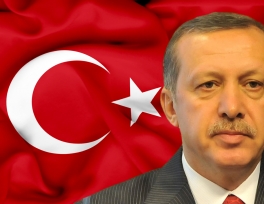
Turkish President Recep Tayyip Erdogan.
To make the story even more compelling, an opposition leader braves the wrath of the autocrat by seeking to expose these intelligence schemes, including the cover-up of key evidence. The autocrat’s government then seeks to prosecute the critic for “treason.”
But the problem with this story, as far as the American government and press are concerned, is that the autocratic leader, President Recep Tayyip Erdogan, is in charge of Turkey, a NATO ally and his hated neighbor is the much demonized Syrian President Bashar al-Assad. Major U.S. news outlets and political leaders also bought into the sarin deception and simply can’t afford to admit that they once again misled the American people on a matter of war.
The Official Story of the sarin attack – as presented by Secretary of State John Kerry, Human Rights Watch and other “respectable” sources – firmly laid the blame for the Aug. 21, 2013 atrocity killing hundreds of civilians outside Damascus on Assad. That became a powerful “group think” across Official Washington.
Though a few independent media outlets, including Consortiumnews.com, challenged the rush to judgment and noted the lack of evidence regarding Assad’s guilt, those doubts were brushed aside. (In an article on Aug. 30, 2013, I described the administration’s “Government Assessment” blaming Assad as a “dodgy dossier,” which offered not a single piece of verifiable proof.) (Click here for rest of article.)
JOHN KIRIAKOU NAMED WINNER OF 2016 SAM ADAMS AWARD FOR EXPOSING CIA TORTURE
December 14, 2015 — FOR IMMEDIATE RELEASE
The Sam Adams Associates for Integrity in Intelligence announces the selection of John Kiriakou as the 15th recipient of the annual Sam Adams Award for Integrity in Intelligence.
Kiriakou, a former CIA counterterrorism officer, in 2007 became the first US Government official to publicly confirm and describe CIA use of waterboarding on al-Qaeda prisoners, which he described as torture.
In January 2013, Kiriakou was sentenced to 30 months in prison and was released earlier this year after serving more than 23 months. Since then, he has become a tireless writer and speaker on whistleblowing, torture, and civil liberties. John’s story, as well as that of his attorney, Jesselyn Radack (herself a former Justice Department whistleblower), and former NSA senior executive Thomas Drake is told in “Silenced,” a James Spione film.
Kiriakou is the sole US Government official to have been jailed for any reason relating to CIA torture – a victim of the Obama administration’s unprecedented crackdown on government truth-tellers. John was in federal prison, when President Obama openly acknowledged at a White House press conference on August 1, 2014, “We tortured some folks.” John was in prison for having said essentially the same thing seven years earlier.
Reacting to word that he had been chosen for the award, Kiriakou stated that he is “honored and absolutely humbled.”
Additional information about John Kiriakou is contained in this article by Ray McGovern on the occasion of John’s being honored in 2015, by the PEN Center USA, the West Coast branch of PEN International (a human rights and literary arts organization that promotes the written word and freedom of expression), which gave John Kiriakou its First Amendment Award for his role in exposing waterboarding as torture used during President George W. Bush’s “war on terror:” https://consortiumnews.com/2015/11/18/cia-whistleblower-kiriakou-honored/
The fourteen previous Sam Adams Award recipients are:
Coleen Rowley, Katharine Gun, Sibel Edmonds, Craig Murray, Sam Provance, Frank Grevil, Larry Wilkerson, Julian Assange, Thomas Drake, Jesselyn Radack, Thomas Fingar, Edward Snowden, Chelsea Manning, and William Binney.
Additional information on Sam Adams (1934-1988), the former CIA analyst in whose honor the award was established, as well as on earlier awardees, is available at: https://samadamsaward.ch/history-of-the-sam-adams-award/