
Know all ye by these presents that Annie Machon is hereby honored with the traditional Sam Adams Corner-Brightener Candlestick Holder, in symbolic recognition of her courage in shining light into dark places.

“If you see something, say something.” Long before that saying came into vogue, Annie Machon took its essence to heart.
MI5, the British domestic intelligence agency, recognized how bright, enterprising, and unflappable Annie was and recruited her as soon as she completed her studies at Cambridge.
The good old boys in MI5 apparently thought she would have a malleable conscience, as well — such that she would have no qualms about secret monitoring of the very government officials overseeing MI5 itself, for example.
Annie would not be quiet about this secret abuse. Her partner, David Shayler, an MI5 colleague and — like Annie — a person of integrity and respect for law, became aware of an MI6 plan to assassinate Libyan leader Muammar Gaddafi.
They decided to blow the whistle and fled to France. (Many years later, a woman of high station but more flexible integrity openly gloated over Gaddafi’s brutal assassination.)
After three years on the lam, hiding mostly in France, they returned to the UK, where Annie was arrested (but never charged with a crime). The powers-that-be, however, chose to make an example of Shayler (not unlike what they are now doing to Julian Assange).
Shayler’s whistleblowing case dragged on for seven years, during which he did a brief stint in the infamous high-security prison where Julian Assange still rots (having been denied bail, yet again). A strong mitigation plea by Annie helped reduce Shayler’s remaining prison time. All in all, though, what he was forced to endure took a hard toll on him.
More broadly, the issues that surfaced around whistleblowing at the time remain largely the same two decades later. Annie Machon has been a very prominent and strong supporter of Julian. She has also been a much admired mentor to less experienced women and men as they seek to become better informed on issues of integrity and courage, and take Annie up on her offer to “help them meet interesting people”, as she puts it.
We would be remiss today were we not to call to mind the courageous example of our first two awardees, Coleen Rowley (FBI) and Katharine Gun (GCHQ), who took great risks in exposing malfeasance and in trying to head off the attack on Iraq. And, as Julian Assange did when he won this award, we again honor his treasured source, Chelsea Manning, for her continuing courage and scarcely believable integrity.
Ed Snowden, our Sam Adams awardee in 2013, noted that we tend to ignore some degree of evil in our daily life, but, as Ed put it, “We also have a breaking point and when people find that, they act.”
Annie is still acting, as one can see as this World Ethical Data Forum unfolds.
Presented this 17th day of March at the World Ethical Data Forum by admirers of the example set by the late CIA analyst, Sam Adams.
Related Articles
Colonel Lawrence Wilkerson & the Power of the Industrial Military Complex
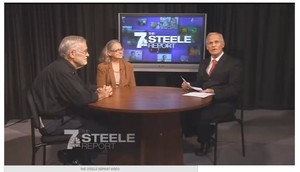
Ray McGovern and Coleen Rowley Featured on the Steele Report
FBI Whistleblower Coleen Rowley and Former CIA Analyst Ray McGovern sit down with news analyst, Ron Steele to present specific questions individuals should ask presidential candidates.
VFP Iowa Chapters sponsored the Rowley/McGovern speaking tour in September. The tour sought to raise the level of Iowans understanding of current national security issues. The tour also focused on specific issues that Iowa caucus-goers may raise at the February caucuses.
Snowden warns of dangers of surveillance
Edward Snowden warned an Iowa City audience Monday of the dangers of the public becoming more accountable to the government at a time when the government is becoming less accountable to the public.
“The real danger here is that mass surveillance doesn’t actually keep us safe, it puts us at greater risk of harm, ” Snowden told an audience at the Englert Theatre via video link Monday. “Because when you do what NSA does — their internal classified slogan is ‘collect it all’ — when you collect everything, you understand nothing.”
 Whistle-blower Edward Snowden appears via video link Monday during a lecture at the Englert Theatre. On stage are activists Ray McGovern and Coleen Rowley.(Photo: Josh O’Leary / Iowa City Press-Citizen)
Snowden, the former intelligence worker who made headlines worldwide when he leaked classified information about the National Security Agency’s surveillance of U.S. citizens in 2013, has been living in Russia under asylum since fleeing the U.S. He received a standing ovation by many in the audience at the packed theater during an event hosted by the University of Iowa’s Lecture Committee.
Snowden was a last-minute addition — his appearance was announced Friday — to the event, which featured talks by former CIA analyst Ray McGovern and FBI whistle-blower Coleen Rowley. The former NSA systems analyst spoke at length about the dangers of a government using electronic data to monitor its citizens unchecked.
(click here for full article)
Should ‘He’ Flee? Whistleblowers Worry for New Drone Leaker
A notable leak to the press could result in prosecution.

National security whistleblowers and their supporters say whoever leaked a batch of classified documents about the U.S. government’s drone warfare efforts to The Intercept should brace for the fury of federal prosecutors.
The Intercept says articles it published Thursday are based on classified slides from 2011 through 2013 provided by an unnamed source who opposes the U.S. policy of using drones to assassinate suspected terrorists. Exiled whistleblower Edward Snowden worked as a government contractor until 2013, but the source of the drone documents is described as new by Intercept journalists.
The person or persons responsible for the leak — identified with a singular “he” in one of the news publication’s articles — could face decades behind bars if charged with violating the Espionage Act of 1917, which bars defendants from telling jurors why they disclosed classified information.
The Espionage Act is a popular tool for Obama administration prosecutors, who have used the law in more prosecutions of journalist sources than all previous administrations combined.
“If they’ve shared documents like Edward Snowden, then they will come at them with the Espionage Act for sure if they’re classified,” says retired National Security Agency analyst William Binney.
Binney and other NSA veterans raised concern through official channels about privacy and waste at the NSA. Their homes later were raided by the FBI and a fellow critic then still with the NSA, Thomas Drake, was prosecuted for allegedly violating the Espionage Act in a case that fell apart before trial.
Drake ultimately pleaded guilty in 2011 to exceeding authorized use of an agency computer, a misdemeanor. Drake and Binney have supported Snowden’s decision to flee the country before journalists published his documents exposing mass surveillance, citing their own experiences.
Snowden himself cited their years-long struggle as a reason he relocated first to Hong Kong and then Russia — where he was stranded en route to Latin America when the State Department canceled his passport — rather than stay in the U.S.
(Click for full article on US News and World Report)
Wie werden Kriege gemacht – 18.09.2015 – Highlights
EN) Short version. Complete video can be watched here: https://youtu.be/W7Lia8caiZM
Video shows an event of German peace and civil rights organisations, that took place in Lutherkirche Südstadt Cologne (http://www.lutherkirche-koeln.de) on September 18th, 2015.
Ray McGovern and Elizabeth Murray are members of the Veteran Intelligence Professionals for Sanity (V.I.P.S., http://warisacrime.org/vips), a group of former high-ranking U.S. intelligence officers, who began co-operation in connection with the U.S.A.’s and other states’ attack on Iraq in 2003 and, since then, have been addressing their critical analyses and recommendations to the governments of the U.S. and Germany.
Until his retirement in 1990, Ray McGovern (http://www.raymcgovern.com) served as CIA Senior Analyst, being responsible for the reporting on the Soviet Union to the White House. Elizabeth Murray worked as Deputy National Intelligence Director at National Intelligence Council until her early retirement in 2010. She was responsible for reporting on the Near and Middle East to the U.S. government.