Demonstrators protesting the Dakota Access Pipeline have resorted to social media and outside news sources to get out their message as N.Dakota police reportedly use tear gas, water cannon and concussion grenades, says political analyst Elizabeth Murray .
Police have reportedly deployed water cannon on the protesters, many of whom were trapped on a bridge at the scene, in sub-zero temperatures, and are using LRAD sound devices. There were also reports of police firing rubber bullets into the crowd.
Construction of the $3.7 billion pipeline has been inciting protests since the spring, with the Sioux tribe and environmental activists claiming the project threatens local water sources, as well sacred Indian sites, including burial grounds.
Once on-line, the 1,200-mile pipeline will carry 500,000 gallons of crude oil daily from North Dakota through South Dakota and Iowa to a distribution point in Illinois.
Kelcy Warren, CEO of Energy Transfer Partners, the company constructing the pipeline, told PBS last week the work was not being carried out on Native American property.
“We’re on private land,” and the pipeline is “new steel pipe,” he said.
Political analyst Elizabeth Murray provides her view of the demonstrations and how the US media has shied away from reporting on the disturbing drama.
RT: Tear gas and rubber bullets have reportedly been used to disperse the protests. Why do you think they’re use such strong force against protestors who say they’re acting peacefully?
Elizabeth Murray: This has been a full-blown assault on completely peaceful, non-violent protesters. I did see several reports, as yet unconfirmed, that the ground was vibrating underneath the area where the pipeline is being constructed and that it’s quite possible that this attack tonight could be a cover – actually, a distraction – while underground drilling is taking place.
As we know, Energy Transfer Partners has openly defied both the Army Corp of Engineers and the president’s urge to temporarily halt while the Army Corp of Engineers reviews whether they can go ahead with this. It’s possible that they may be trying to start drilling under the river tonight, and again, that’s unconfirmed, but I wouldn’t be surprised and I wouldn’t put it past Energy Transfer Partners, which has already said that any kind of alternative route is out of the question and that they intend to drill there…
RT:What do you think about protestors saying the police shot down their drone to prevent them from filming?
EM: I heard the same thing. I’ve been following the events rather closely on Twitter, but this is clearly an attempt to keep this out of the public eye. I understand that as this has been unfolding tonight, CNN, for example, has been busy going over the Hamilton theater incident with Vice President-elect Mike Pence and hasn’t given any attention to this issue. Fortunately, we’ve had not only RT but all kinds of citizen journalists live-streaming so they’re actually able to give citizens facts on the ground.
As you’ve mentioned and shown tonight, people were sprayed with water cannons in 25-degree cold.
Meanwhile, the Morton County Sheriff is apparently denying that they’ve used water cannons, but thanks to social media, people can get on-line and check out the live-streaming that has been going on through the night and see the terror that these non-violent water protectors are being subjected to.
It’s really appalling.
The statements, views and opinions expressed in this column are solely those of the author and do not necessarily represent those of RT. (Full article here.)
This Veterans Day, instead of using the day to assuage our collective guilt by thanking military veterans for their service in what’s now called “the perpetual war,” why not instead ask one or two for their opinions on the hard questions? While some might be reluctant to share their innermost feelings, gentle probing sometimes gets results. Admittedly, we veterans do this gentle probing the best because a fellow veteran knows something about what they’ve been through—and that we care genuinely for his or her answers.
When I was at Walter Reed National Military Medical Center a year or so ago, I met a multiple-amputee. He had been badly wounded while attempting to defuse an improvised explosive device in Afghanistan. As we sipped coffee together in the hospital’s main lobby, he began to talk to me straightforwardly and candidly. He told me he had just been visited by a congressional delegation. He smiled slyly as he told me that he had succeeded in running them off. They had entered his room together, immediately thanking him for his service. He had cut them off in midsentence, saying: “Don’t thank me for my service because I’m conflicted over that. You can thank me for my sacrifice which you can plainly see.” The entire delegation departed the room rather swiftly.
Today, it is crucial to listen to that less-than-1-percent of us who have gone into harm’s way on behalf of the other 99 percent. It is crucial because the country is perched on the edge of a dangerous new Cold War, potentially more military deployments to western Asia, and a looming battle in the South China Sea. This is to say nothing of the growing likelihood of the use of nuclear weapons, from Korea to Ukraine, and of a Congress dead-set on unraveling theonly successful diplomacy in several years, the nuclear agreement with Iran.
Does our nation’s ever-increasing militarization cause abuses of power, as almost every one of our Founders warned it would? Could our massive and costly counter-terrorism efforts be counterproductive? Do mass surveillance, indefinite detention, torture, ceaseless war and the expenditure of a trillion-plus dollars every year for national security, help or hurt our real security? If we always look forward and never backward, are we doomed to repeat history’s most serious mistakes? Could we be sleepwalking right into World War III?
What if we could ask the hard questions of someone like World War II General Dwight Eisenhower, architect of the Normandy landings and our 34th President? In January 1961, Ike presciently tried to warn us about the dangers of the Military Industrial Complex, now more accurately called a “globalmerchant of death.” He also expressed grave misgivings about nuclear weapons and the decision to use them in 1945 against Japan. Strange thoughts for a five-star general — unless we stop to think about the pinpoint accuracy of his remarks about the Complex and the almost religious intensity of his dislike for weapons of mass destruction. Truth about war more often emanates from the warrior than the non-warrior. We needn’t wonder why.
What advice might America’s veterans of the First World War give us? In 1918, at the 11th hour, on the 11th day, of the 11th month, the armistice for the “war to end all wars” was signed in Compiègne, France. The date and specific timing were carefully chosen as a lasting symbol of that goal to end war for all time. While this eleventh day of November is still commemorated as “Armistice Day” in most countries, in 1954 the name and focus were shifted in the U.S. to “Veterans Day.” Would the WWI doughboys be disappointed in our having relinquished that lofty goal? Have we conceded that we will be locked in perpetual war for the foreseeable future, war with its insatiable consumption and waste of lives, treasure and the environment?
This Nov. 11, ask a veteran what he or she thinks about all this. Ask them the hard questions. You might be surprised by their answers.
Lawrence Wilkerson, a retired U.S. Army colonel, was chief of staff to former Secretary of State Colin Powell. He teaches national security affairs at the College of William and Mary in Williamsburg, Va. Wilkerson is scheduled to speak at Armistice Day events in the Twin Cities, including during a forum at Hamline University at 11:30 a.m. Nov. 10, where he will be joined by the Rev. Chris Antal, a former U.S. Army chaplain in Afghanistan.
Truth about war more often emanates from the warrior than the non-warrior. We needn’t wonder why.
——Videos of Armistice Day Forums in the Twin Cities Nov 10-11, 2016——————
A group of ex-U.S. intelligence officials is warning President Obama to defuse growing tensions with Russia over Syria by reining in the demonization of President Putin and asserting White House civilian control over the Pentagon. (Originally published on Oct 2, 2016 on Consortiumnews.com)
ALERT MEMORANDUM FOR: The President
FROM: Veteran Intelligence Professionals for Sanity
SUBJECT: PREVENTING STILL WORSE IN SYRIA
We write to alert you, as we did President George W. Bush, six weeks before the attack on Iraq, that the consequences of limiting your circle of advisers to a small, relatively inexperienced coterie with a dubious record for wisdom can prove disastrous.* Our concern this time regards Syria.
We are hoping that your President’s Daily Brief tomorrow will give appropriate attention to Saturday’s warning by Russia’s Foreign Ministry spokesperson Maria Zakharova: “If the US launches a direct aggression against Damascus and the Syrian Army, it would cause a terrible, tectonic shift not only in the country, but in the entire region.”
Speaking on Russian TV, she warned of those whose “logic is ‘why do we need diplomacy’ … when there is power … and methods of resolving a problem by power. We already know this logic; there is nothing new about it. It usually ends with one thing – full-scale war.”
We are also hoping that this is not the first you have heard of this – no doubt officially approved – statement. If on Sundays you rely on the “mainstream” press, you may well have missed it. In the Washington Post, an abridged report of Zakharova’s remarks (nothing about “full-scale war”) was buried in the last paragraph of an 11-paragraph article titled “Hospital in Aleppo is hit again by bombs.” Sunday’s New York Times totally ignored the Foreign Ministry spokesperson’s statements.
In our view, it would be a huge mistake to allow your national security advisers to follow the example of the Post and Times in minimizing the importance of Zakharova’s remarks.
Events over the past several weeks have led Russian officials to distrust Secretary of State John Kerry. Indeed, Foreign Minister Sergey Lavrov, who parses his words carefully, has publicly expressed that distrust. Some Russian officials suspect that Kerry has been playing a double game; others believe that, however much he may strive for progress through diplomacy, he cannot deliver on his commitments because the Pentagon undercuts him every time. We believe that this lack of trust is a challenge that must be overcome and that, at this point, only you can accomplish this.
It should not be attributed to paranoia on the Russians’ part that they suspect the Sept. 17 U.S. and Australian air attacks on Syrian army troops that killed 62 and wounded 100 was no “mistake,” but rather a deliberate attempt to scuttle the partial cease-fire Kerry and Lavrov had agreed on – with your approval and that of President Putin – that took effect just five days earlier.
In public remarks bordering on the insubordinate, senior Pentagon officials showed unusually open skepticism regarding key aspects of the Kerry-Lavrov deal. We can assume that what Lavrov has told his boss in private is close to his uncharacteristically blunt words on Russian NTV on Sept. 26:
“My good friend John Kerry … is under fierce criticism from the US military machine. Despite the fact that, as always, [they] made assurances that the US Commander in Chief, President Barack Obama, supported him in his contacts with Russia (he confirmed that during his meeting with President Vladimir Putin), apparently the military does not really listen to the Commander in Chief.”
Lavrov’s words are not mere rhetoric. He also criticized JCS Chairman Joseph Dunford for telling Congress that he opposed sharing intelligence with Russia, “after the agreements concluded on direct orders of Russian President Vladimir Putin and US President Barack Obama stipulated that they would share intelligence. … It is difficult to work with such partners. …”
Policy differences between the White House and the Pentagon are rarely as openly expressed as they are now over policy on Syria. We suggest you get hold of a new book to be released this week titled The General vs. the President: MacArthur and Truman at the Brink of Nuclear War by master historian H. W. Brands. It includes testimony, earlier redacted, that sheds light on why President Truman dismissed WWII hero Gen. Douglas MacArthur from command of U.N. forces in Korea in April 1951. One early reviewer notes that “Brands’s narrative makes us wonder about challenges of military versus civilian leadership we still face today.” You may find this new book more relevant at this point in time than the Team of Rivals.
The door to further negotiations remains ajar. In recent days, officials of the Russian foreign and defense ministries, as well as President Putin’s spokesman, have carefully avoided shutting that door, and we find it a good sign that Secretary Kerry has been on the phone with Foreign Minister Lavrov. And the Russians have also emphasized Moscow’s continued willingness to honor previous agreements on Syria.
In the Kremlin’s view, Russia has far more skin in the game than the U.S. does. Thousands of Russian dissident terrorists have found their way to Syria, where they obtain weapons, funding, and practical experience in waging violent insurgency. There is understandable worry on Moscow’s part over the threat they will pose when they come back home. In addition, President Putin can be assumed to be under the same kind of pressure you face from the military to order it to try to clean out the mess in Syria “once and for all,” regardless how dim the prospects for a military solution are for either side in Syria.
We are aware that many in Congress and the “mainstream” media are now calling on you to up the ante and respond – overtly or covertly or both – with more violence in Syria. Shades of the “Washington Playbook,” about which you spoke derisively in interviews with the Atlantic’s Jeffrey Goldberg earlier this year. We take some encouragement in your acknowledgment to Goldberg that the “playbook” can be “a trap that can lead to bad decisions” – not to mention doing “stupid stuff.”
Goldberg wrote that you felt the Pentagon had “jammed” you on the troop surge for Afghanistan seven years ago and that the same thing almost happened three years ago on Syria, before President Putin persuaded Syria to surrender its chemical weapons for destruction. It seems that the kind of approach that worked then should be tried now, as well – particularly if you are starting to feel jammed once again.
Incidentally, it would be helpful toward that end if you had one of your staffers tell the “mainstream” media to tone down it puerile, nasty – and for the most part unjustified and certainly unhelpful – personal vilification of President Putin.
Renewing direct dialogue with President Putin might well offer the best chance to ensure an end, finally, to unwanted “jamming.” We believe John Kerry is correct in emphasizing how frightfully complicated the disarray in Syria is amid the various vying interests and factions. At the same time, he has already done much of the necessary spadework and has found Lavrov for the most part, a helpful partner.
The Security Council adopted resolution 2310 (2016) urging all States that have either not signed or not ratified the Comprehensive Nuclear-Test-Ban Treaty (CTBT) to do so without further delay. The Council also called upon all States to refrain from conducting any nuclear-weapon test explosion or any other nuclear explosion and to maintain their moratoria in this regard. The resolution was adopted with a vote of 14 in favour, and one abstention (Egypt).
Still, in view of lingering Russian – and not only Russian – skepticism regarding the strength of your support for your secretary of state, we believe that discussions at the highest level would be the best way to prevent hotheads on either side from risking the kind of armed confrontation that nobody should want.
Therefore, we strongly recommend that you invite President Putin to meet with you in a mutually convenient place, in order to try to sort things out and prevent still worse for the people of Syria.
In the wake of the carnage of World War II, Winston Churchill made an observation that is equally applicable to our 21st Century: “To jaw, jaw, jaw, is better than to war, war, war.”
* In a Memorandum to President Bush criticizing Colin Powell’s address to the UN earlier on February 5, 2003, VIPS ended with these words: “After watching Secretary Powell today, we are convinced that you would be well served if you widened the discussion … beyond the circle of those advisers clearly bent on a war for which we see no compelling reason and from which we believe the unintended consequences are likely to be catastrophic.”
For the Steering Group, Veteran Intelligence Professionals for Sanity
William Binney, former Technical Director, World Geopolitical & Military Analysis, NSA; co-founder, SIGINT Automation Research Center (ret.)
Fred Costello, Former Russian Linguist, USAF
Mike Gravel, former Adjutant, top secret control officer, Communications Intelligence Service; special agent of the Counter Intelligence Corps and former United States Senator
Matthew Hoh, former Capt., USMC, Iraq & Foreign Service Officer, Afghanistan (associate VIPS)
Larry C. Johnson, CIA & State Department (ret.)
John Kiriakou, former CIA counterterrorism officer and former senior investigator, Senate Foreign Relations Committee
Linda Lewis, WMD preparedness policy analyst, USDA (ret.) (associate VIPS)
Edward Loomis, NSA, Cryptologic Computer Scientist (ret.)
Ray McGovern, former US Army infantry/intelligence officer & CIA analyst (ret.)
Elizabeth Murray, Deputy National Intelligence Officer for Middle East, CIA (ret.)
Todd Pierce, MAJ, US Army Judge Advocate (ret.)
Coleen Rowley, Division Counsel & Special Agent, FBI (ret.)
Kirk Wiebe, former Senior Analyst, SIGINT Automation Research Center, NSA, (ret.)
Robert Wing, former Foreign Service Officer (associate VIPS)
Ann Wright, U.S. Army Reserve Colonel (ret) and former U.S. Diplomat
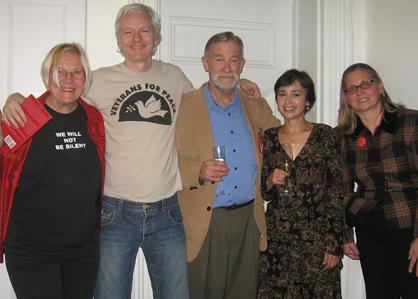
Sam Adams Associates for Integrity in Intelligence is a movement of former CIA colleagues of former intelligence analyst Sam Adams, together with others who hold up his example as a model for those in intelligence who would aspire to the courage to speak truth to power. SAAII confers an award each year to a member of the intelligence community or related professions who exemplifies Sam Adam’s courage, persistence, and devotion to truth – no matter the consequences. Read more about the history here.
The annual Sam Adams Award has been given in previous years to truth tellers Coleen Rowley of the FBI; Katharine Gun of British Intelligence; Sibel Edmonds of the FBI; Craig Murray, former UK ambassador to Uzbekistan; Sam Provance, former US Army Sgt; Maj. Frank Grevil of Danish Army Intelligence; Larry Wilkerson, Col., US Army (ret.), former chief of staff to Colin Powell at State; Julian Assange, of WikiLeaks: Thomas Drake, of NSA; Jesselyn Radack, formerly of Dept. of Justice and now National Security Director of Government Accountability Project; Thomas Fingar, former Deputy Director of National Intelligence and Director, National Intelligence Council, and Edward Snowden, former contractor for the National Security Agency; Chelsea Manning, US Army Private who exposed (via WikiLeaks) key information on Afghanistan and Iraq, as well as State Department activities; and to retired National Security Agency official William Binney, who challenged decisions to ignore the Fourth Amendment in the government’s massive — and wasteful — collection of electronic data.

 Sam Adams Associates for Integrity in Intelligence is a movement of former CIA colleagues of former intelligence analyst Sam Adams, together with others who hold up his example as a model for those in intelligence who would aspire to the courage to speak truth to power. SAAII confers an award each year to a member of the intelligence community or related professions who exemplifies Sam Adam’s courage, persistence, and devotion to truth – no matter the consequences. Read more about the history here.