News
If, as seems likely, President Barack Obama retains enough support to complete the nuclear deal with Iran, it will be largely because enough members of the House and Senate are persuaded by his argument that the only other real option is war..
This was the rhetorical gauntlet the president threw down at his press conference last week. Equally significant, Mr. Obama omitted the until-now obligatory warning that “all options, including the military one, remain on the table.”
Since then, Israeli media have been pressing hard to restore the military option to its accustomed place “on the table.” Flying to Israel Sunday night for a handholding mission with top Israeli officials, U.S. Defense Secretary Ashton Carter tried to make his reception in Tel Aviv less frosty, telling accompanying journalists that the nuclear deal with Iran “does nothing to prevent the military option.” The context, however, seemed to be one in which Iran was caught cheating on the nuclear deal.
That this kind of rhetoric, even when it is not from the president, is still poison to Tehran was clear in the immediate reaction by Iran’s Foreign Minister, Mohammad Javad Zarif, who insisted Monday: “Applying force … is not an option but an unwise and dangerous temptation.”
(Click here for rest of article.)
 (Protesters burn an illustration of a Japanese military flag featuring a portrait of Hideki Tojo, Japan’s prime minister during World War Two, during a demonstration outside the Japanese Consulate in Hong Kong, July 7, 2015. REUTERS/Bobby Yip)
(By Peter Van Buren) Nearly to the day of the first successful test of a nuclear bomb in 1945, and just a few weeks from the 70th anniversary of the end of World War Two, Japanese Prime Minister Shinzo Abe pushed through legislation to give his country’s military the power to strike offensively for the first time since the war.
It is hard to understate the potential impact of this development.
Domestically, Abe is putting his own job on the line. Voters oppose the new legislation roughly two to one, opposition parties walked out of the vote in protest and the government’s support ratings fell to around 40 percent. The lower house of parliament’s decision to approve the legislation set off the largest demonstrations in Japan since the Fukushima nuclear accident; a crowd of 100,000 people gathered with signs reading “Abe, Quit.”
Abe took this action knowing that 55 years ago similar protests forced his grandfather, Nobusuke Kishi, out of the prime minister’s job after he rammed a revised U.S.-Japan security pact, seen as too militaristic, through parliament.
Abe’s move is also darkly symbolic both in and outside Japan.
Most Japanese remain proud of Article 9 in their postwar constitution, through which they became the only nation in modern times to renounce the use of offensive force. Abe’s walking his country away from this achievement represents the end of the last great ideal to emerge from World War Two, and an almost contemptuous disregard for his citizens’ view of themselves.
(Click here for rest of article.)
(Report below from Ray McGovern)
The occasion was the annual meeting of the Academy of Philosophy and Letters, June 13, 2015, at the BWI Doubletree Hotel — oddly, surrounded by NSA buildings in Linthicum, MD.

The evening program was hosted by John Henry, of the Committee for the Republic.
The topic was: “The National Security Agency’s War on the U.S. Constitution”
Speakers: William Binney, Kirk Wiebe, Thomas Drake, James Bamford, Bruce Fein, John Henry, and Ray McGovern
The Committee for the Republic was pleased to afford an appropriate occasion for William Binney to receive the framed citation (in English and German) for the Sam Adams Award for Integrity in Intelligence. The award was originally presented to Binney at an SRO ceremony in Berlin on January 22, 2015.
Ed Snowden, who was live-streamed into that Berlin ceremony, emphasized that “Without Bill Binney there would be no Ed Snowden.” Bill, in turn, had been greatly encouraged by the courageous, principled stand taken by Tom Drake in facing down the U.S. Department of Justice and NSA successfully, after four years of persecution that included government-provided “evidence” proven in Court to have been forged.
Actually, in a very real sense, it was a triple-play: Drake to Binney to Snowden. So it was altogether appropriate that Tom Drake be the Sam Adams Associate to present the framed award to Bill Binney on June 13, 2015 in the belly of the (NSA) beast.
Tom also had been the clear choice of his colleague Sam Adams Associates to present the 2013 award for integrity in intelligence to Ed Snowden in Moscow on October 7, 2013. As soon as Ed surfaced in Hong Kong, he made it clear that the U.S. government abuse of Tom had convinced Ed that he had to leave the U.S. in order to achieve his mission and have some chance — however slight it seemed at the time — of avoiding spending the rest of his life in prison.
Hats off to Drake to Binney to Snowden: courageous patriots all!
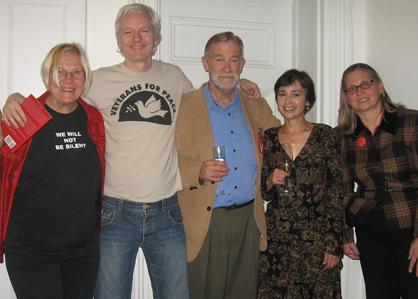 Sam Adams Associates for Integrity in Intelligence is a movement of former CIA colleagues of former intelligence analyst Sam Adams, together with others who hold up his example as a model for those in intelligence who would aspire to the courage to speak truth to power. SAAII confers an award each year to a member of the intelligence community or related professions who exemplifies Sam Adam’s courage, persistence, and devotion to truth – no matter the consequences. Read more about the history here.
The annual Sam Adams Award has been given in previous years to truth tellers Coleen Rowley of the FBI; Katharine Gun of British Intelligence; Sibel Edmonds of the FBI; Craig Murray, former UK ambassador to Uzbekistan; Sam Provance, former US Army Sgt; Maj. Frank Grevil of Danish Army Intelligence; Larry Wilkerson, Col., US Army (ret.), former chief of staff to Colin Powell at State; Julian Assange, of WikiLeaks: Thomas Drake, of NSA; Jesselyn Radack, formerly of Dept. of Justice and now National Security Director of Government Accountability Project; Thomas Fingar, former Deputy Director of National Intelligence and Director, National Intelligence Council, and Edward Snowden, former contractor for the National Security Agency; Chelsea Manning, US Army Private who exposed (via WikiLeaks) key information on Afghanistan and Iraq, as well as State Department activities; and to retired National Security Agency official William Binney, who challenged decisions to ignore the Fourth Amendment in the government’s massive — and wasteful — collection of electronic data.
